

The Naturalization Interview is one of the most important steps...
Read MoreEB-2 NIW : Getting a Green Card Without An Employer
Yasin Bilgehan Akalan
Attorney at Law
Immigration Law Expert – Akalan Law Firm
The EB-2 National Interest Waiver (NIW) is a pretty sweet deal for highly skilled professionals looking to get a U.S. Green Card without the need for a job offer or an employer to sponsor them. This visa path was set up to let individuals whose work is worth a lot to the United States, cut through the usual red tape and get the green card more quickly.
If you have a master’s degree, or in some cases a bachelor’s degree plus a solid 5 years of progressive experience, and your work is doing something that’s really good for the U.S., you may be eligible for the NIW visa. It’s a privilege reserved for individuals with advanced degrees or a deep well of experience in fields like science, tech, arts or business, and whose work is genuinely going to make a difference in the States.
The EB-2 NIW lets people with a high level of expertise in areas like science, tech, the arts or business to apply for a U.S. green card, without needing to get a job offer or employer sponsorship. When you apply for a National Interest Waiver, USCIS (United States Citizenship and Immigration Services) looks at your occupation, expertise, and proposed project to see if you’re the right fit for the program. This is basically a special exemption that lets you skip over the usual requirements because your work is so valuable to the U.S.
If you’re going to qualify for the EB-2 NIW, you’ll need to tick a few boxes:
It’s super important that you have some strong supporting evidence to back up all the eligibility criteria so your EB-2 NIW petition stands a good chance.
USCIS will use the three-part test from Matter of Dhanasar to evaluate your NIW petition. This means they’ll look at:\
USCIS will make their final decision on the merits by considering everything you’ve submitted and how well you meet the Dhanasar criteria for national interest.
The EB-2 NIW gives a bunch of advantages to highly skilled professionals who want to get a green card in the U.S. One of the best bits is that you can self-petition, which means you can apply without having to get an employer to sponsor you. And the best part is that you don’t need to go through the labor certification process, which is often the bottleneck for green card applications for working individuals.Overall, the EB-2 National Interest Waiver offers a fantastic opportunity for foreign nationals to secure permanent residency, make a meaningful contribution to the national interest, and really advance their careers and proposed projects in the United States – all without having to go through the hassle of employer sponsorship or labor certification hoops.
The O-1 visa, issued by the U.S. Citizenship and Immigration Services (USCIS), is a work authorization for individuals who show extraordinary ability in science, education, business, arts, or sports.
The application process for an EB-2 NIW starts with filing an immigrant petition, specifically Form I-140 with the U.S. Citizenship and Immigration Services (USCIS). That’s your first step in getting an immigrant visa and ultimately landing lawful permanent resident status in the U.S. The filing fee for Form I-140 is $715, plus a $300 Asylum Program fee.
Note: These fees are the USCIS filing fees that were in effect at the time the article was written. Because USCIS may update its fees from time to time, it is recommended that you check the most current fees on the official USCIS website before submitting your application.
You’ll want to get all the necessary documentation in order – your resume, some rock-solid recommendation letters, and any evidence that showcases your exceptional abilities or advanced education. Make sure those recommendation letters are from the right people – current or former employers, government agencies, or other government entities are all good choices, as they can really help validate the national importance and merit of your proposed work. Recommendation letters from experts in your field can give you a big boost, but if you submit weak or irrelevant letters, it can actually hurt your case.
If the USCIS team doesn’t see enough evidence that you’re eligible for the NIW in your initial submission, they might send you a Request for Evidence (RFE). If that happens, or if your application gets denied or you get an RFE, you may need to come up with some solid legal arguments to address any issues and support motions, appeals, or refilings.
Once your Form I-140 is approved and your priority date has come up according to the Visa Bulletin, you can file Form I-485 for Adjustment of Status if you’re already in the U.S., or do Consular Processing if you’re abroad, to get that lawful permanent resident status.
The processing time for an EB-2 NIW petition can range anywhere from 12 to 16 months, but with premium processing, you can get a decision in as little as 45 business days. Just make sure to regularly check the visa bulletin to see when your priority date is current and you can move forward with your Green Card application.
The priority date is a key part of the EB-2 NIW process. It’s the date your petition is filed, and it determines where you are in line for a Green Card. You’ll need to keep an eye on the visa bulletin to know when your priority date is current and you can proceed with your Green Card application.
The EB-2 National Interest Waiver is a real game-changer for job creation and economic growth in the United States. By bringing in top global talent with exceptional abilities and advanced degrees, the NIW gives the U.S. economy a major boost, through new businesses, industries, and technologies that these professionals can help create. Many of these folks are industry leaders, entrepreneurs, and researchers who are in a great position to advance projects that have real national importance and economic benefit.
One of the core requirements for the NIW is to show that you’re well-placed to advance a project or initiative that will really benefit the U.S. economy or labor market. This can mean launching new startups, expanding existing businesses, or conducting research that creates new job opportunities. By waiving the labor certification requirement and getting rid of the need for a labor market test, the NIW lets employers and the U.S. economy tap into the skills and knowledge of the best candidates, regardless of their nationality.
The NIW can also help stimulate foreign investment and drive economic development, since foreign nationals with advanced degrees or exceptional ability are more likely to invest in the U.S., create jobs, and contribute to the nation’s economic competitiveness. The impact of the NIW can be seen across a range of sectors, including tech, healthcare, finance, and public health, where the contributions of these professionals can really drive positive change.
In short, the EB-2 National Interest Waiver doesn’t just provide a pathway to permanent residency for talented individuals – it also plays a big role in promoting job creation, economic growth, and innovation throughout the United States.
Yes, you can definitely file for the EB-2 National Interest Waiver on your own. This category lets self-petition by a foreign national whose work is going to have a significant benefit to the United States, so you don’t need an employer to sponsor you. You just need to make the case that your work is going to be of real benefit to the U.S.
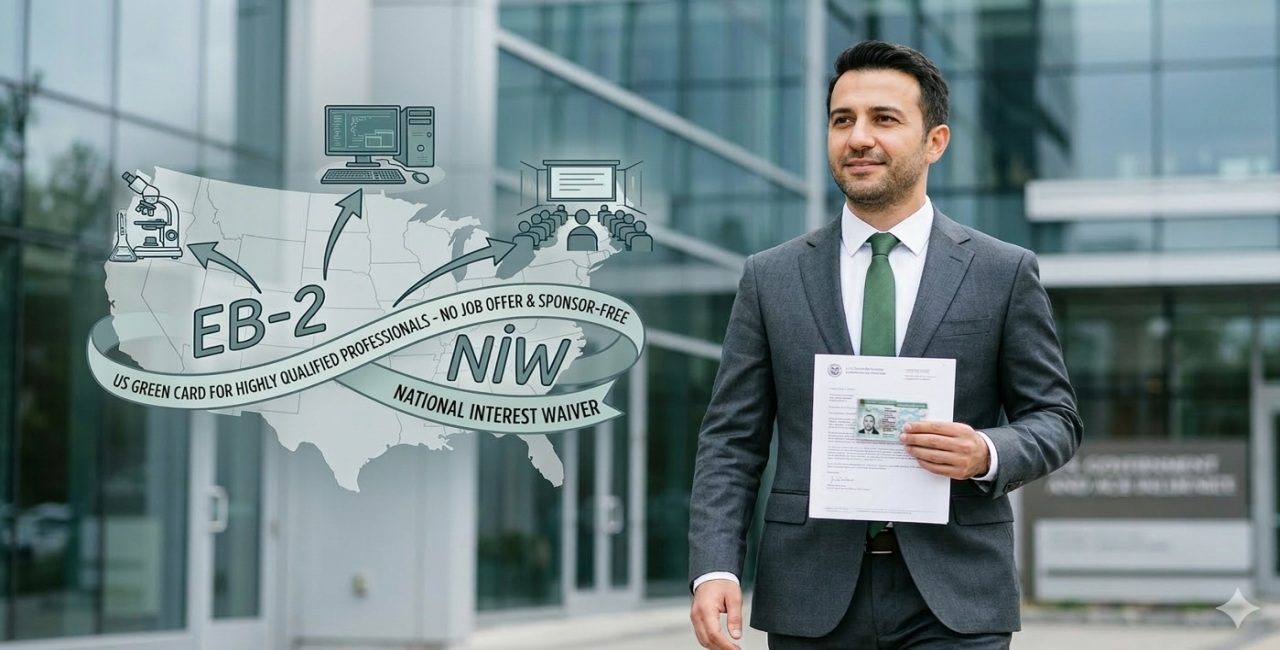
The EB-2 National Interest Waiver is a rare chance for skilled professionals to get a US Green Card without needing employer sponsorship. If you’ve got the right qualifications and you can document them properly, and if you’re careful with the application process, then you increase your chances of success. Just keep your eye on those priority dates and visa bulletin updates, and consider getting some professional help to get the best results.
The EB-2 NIW is a US Green Card category for people who have a high level of expertise in a particular field, and who are applying because their work is useful for the country as a whole. It’s a particularly good choice for people who are academics, engineers, researchers, and entrepreneurs who are making a genuine contribution to the public good.
Yes, the EB-2 NIW is a self-petition process, meaning you can file for it independently without needing a job offer from a U.S. employer.
Normal processing time is about 12 to 16 months, but if you use the premium processing option, you can get it done in 45 business days.
You’ve got to show that your work is going to have a positive impact on the country, that you’re qualified to do the work, and that there’s a good reason why the US should waive the normal job offer and labor certification requirements. Membership in professional organizations can help show you have exceptional abilities, but you’ve got to be able to demonstrate that your expertise is at the top of your field – just being a member isn’t enough.
The priority date is the date when you file your I-140 petition. You need to watch the visa bulletin to see when your priority date is current, so you can then proceed with your Green Card application.
No, you actually can do the EB-2 NIW on your own if you want to – it’s a self-petition process, so you don’t need an offer of a job from a US employer to apply.
The EB-1A is for people who have achieved a really high level of international recognition in their field, often through awards, publications or other media coverage. In contrast, the EB-2 NIW focuses on what you’re going to contribute to the country in the future and the national importance of your proposed work. The EB-1A tends to have higher standards and places more emphasis on past achievements and recognition, whereas the EB-2 NIW looks at the significance of the work you plan to do. Both allow for self-petitioning, but the EB-1A requires much stronger evidence of international acclaim.
No, you don’t need to make a big financial investment to get the EB-2 NIW. That’s a requirement for other immigration pathways, like the EB-5 program, but it’s not a necessary part of the EB-2 NIW.
USCIS wants to see evidence that the proposed project is going to have a really wide-reaching impact and benefit the US as a whole – that’s how it will know that the work is national in importance.
The Naturalization Interview is one of the most important steps...
Read MoreFamily reunification allows U.S. citizens and permanent residents to sponsor...
Read MoreThe EB-5 Immigrant Investor Program offers foreign investors a direct...
Read MoreThe H-1B Visa Project Firewall introduces the most aggressive enforcement...
Read MoreAkalan Law Firm, PLLC
All Rights Reserved © 2024