Immigration Compliance for Remote Work Managing Risks in Hybrid Work Models

Yasin Bilgehan Akalan

Attorney at Law

Immigration Law Expert – Akalan Law Firm

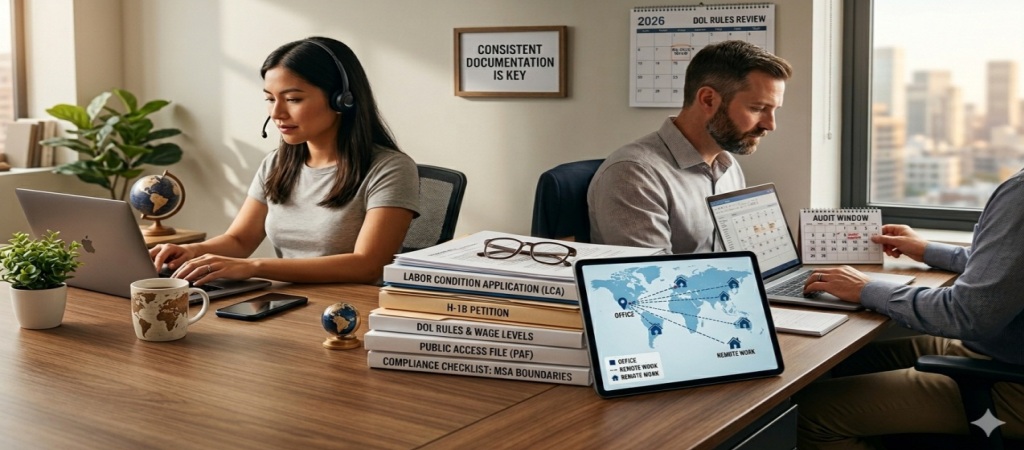
Remote employees working on laptops with global network map and compliance documents representing Immigration Compliance in hybrid work

✅ Introduction 

Immigration compliance has gotten a whole lot trickier with remote work – & that’s thanks to global & hybrid work arrangements that are causing us to re-evaluate where & how we get our work done. When those foreign national workers on H-1B, E-3, or H-1B1 visas decide to work from anywhere other than the office, it suddenly gets a lot more complicated in terms of immigration law. And guess what – this triggers a whole bunch of visa compliance obligations that a lot of employers just aren’t aware of.

The stakes are high, let me tell you. If you don’t keep up with immigration compliance then you risk losing the work authorization for one of your employees, or worse still – you might even face fines or penalties from the Department of Labor (DOL) during an audit. And let me be clear – the DOL is going to be taking a close look at your practices for visa compliance, including your adherence to DOL rules on work locations, job classification, and wage levels. Not to mention that every single location where a visa holder does any work has got to be properly documented through Labor Condition Applications and petitions.

We’re going to walk you through the whole process of managing remote work immigration compliance in this piece. You’ll learn how to spot the common risks in hybrid work models and we’ll give you a complete compliance checklist that’ll keep both your organisation and your global workforce safe.

▶️  Immigration Compliance Requirements for Remote Work

🔹What Remote Work Means for Immigration Law

So just what does immigration law say about remote work? Well, it seems that the ‘place of employment’ is actually where a visa holder does their work – & that’s not necessarily the office. When someone starts working from home, their home address becomes a ‘worksite’ for immigration and labour law purposes. Now, the specific area where work is done matters a lot for immigration status and visa compliance – because if someone changes location, you might need to amend their immigration petition & that could impact their eligibility. This all means that there are specific compliance obligations that kick in, just like they would if they were working from the office.

Consular officers are always on the lookout for whether the worksite listed in the DS-160 matches the employer’s certified location on the LCA. You’ve got to be consistent here. And if you let remote work go on unauthorised, you risk jeopardising a worker’s visa status. The US government is going to be tightening up enforcement even more as remote work becomes the norm.

Immigration regulations are pretty strict when it comes to remote work for international employees. Because they tie work authorisation to specific locations & employers. (20 CFR § 655.715)

🔹Key Visa Types Affected by Remote Work Arrangements

Now the H-1B visa has some pretty tough worksite requirements. H-1B workers are only allowed to work at places listed in the H-1B petition & accompanying Labor Condition Application. The specific visa type determines what work locations & compliance requirements are in play for remote work – because every category has its own rules. If an H-1B worker wants to change locations outside of a Metropolitan Statistical Area, they’re going to need to file an amended petition before they can start work at their new location.

L-1 & TN visas are a bit more flexible, though. They don’t require LCAs, which makes it easier to change work locations. L-1 visa holders can move from an office location to a remote location without filing an amended petition most of the time – but the Fraud Detection and National Security department can always turn up at an L-1 work location to conduct a site inspection.

O-1 visa holders are also okay to work remotely as long as they’re still doing the same job under the same petitioner or agent.  But significant changes to duties or location might require an amended filing.

Hybrid arrangements, where employees split time between office & remote locations, require close compliance monitoring to make sure all the legal & administrative obligations are being met.

▶️ Work Location Documentation Requirements

It’s the Metropolitan Statistical Area that determines whether you need to amend anything. If an employee’s home is within the same MSA as the office location listed on the approved LCA, then they can work from home without filing an H-1B amendment. You’ve still got to post the original LCA at the new home office location for at least 10 business days.

When the home location is outside the MSA, you’ll need to file a new LCA & an amended H-1B petition that lists the new home worksite location. There’s a short-term placement exception that lets H-1B employees work at unlisted sites for up to 30 days – but that can be extended to 60 days within a one-year period if certain conditions are met.

10 Best US Work Visa Options in 2026

About 40% of authorized immigrants who entered the U.S. in 2024 did so on work-related visas. Since 2013, demand for these visas has risen sharply, but annual visa caps and quotas have not expanded at the same pace.

▶️ Labor Condition Application (LCA) Basics

The LCA makes sure that foreign national workers are getting paid at least the prevailing wage for a specific occupation in the region of employment. Employers have to file LCAs with the Department of Labor for H-1B, H-1B1 & E-3 classifications. Each LCA specifies the worksite locations, wages offered, & the period of employment. Even when employees work from home, you still need to post the notices – either on entrances or on a communal bulletin board if people live in apartments.

Employment Law Considerations for Remote and Hybrid WorkNavigating the world of employment law is crucial for any boss trying to get to grips with the ins and outs of running a remote work operation, especially when it comes to foreign national staff. Workers on visas like the H-1B, L-1, or O-1 are not just subject to immigration rules but also have to abide by a whole bunch of employment law requirements too. Employers need to make sure they’re in compliance with federal and state laws, like the Fair Labor Standards Act (FLSA), which lays out the rules for minimum wage, overtime, and keeping accurate records – all of which still apply even if the employee is working remotely.

Managing a remote workforce can also have a big impact on things like employee benefits, workers’ comp insurance, and unemployment insurance eligibility. For instance, if a foreign national worker is doing their job from a different state, the employer may have to rethink their benefits and insurance policies to make sure they comply with the local regulations. Keeping a clear and accurate record of job duties, work hours, and wages is essential, too, to prove that they’re paying their staff the right wage and to avoid any disputes or penalties down the line.

Because dealing with all these overlapping rules is such a minefield, it’s a good idea for employers to get in touch with an immigration lawyer who’s got some serious experience in this area to make sure they’re getting it right on both the immigration and employment law fronts. This is especially important when you’ve got a hybrid work setup, where staff might be splitting their time between the office and working remotely. By doing some serious proactive planning and making sure that remote workers are kept in the loop, employers can stay on the right side of the law and avoid any potential risks.

▶️ Common Compliance Risks in Hybrid Work Models

🔹Employee Relocations Without Proper Notification

You get a problem when an employee decides to move to a new location without telling the immigration team. HR are updating the payroll and internal systems all the time, but they’re not always bothering to let the immigration lawyer know. This leads to all sorts of problems – like failing to post the LCA notice at the new location and not having the right Public Access File documents in place. Then, when you go to extend the employee’s visa, you get hit with all these big fines because USCIS are cross-checking the state tax filings with the approved work locations.

To avoid getting caught out like this, employers should make sure that employees who want to work from outside the country get formal approval first.

🔹Geographic Wage Violations and Prevailing Wage Issues

Different areas of the country have very different prevailing wages. If you don’t tell the DOL about the change of address, you could end up being sued for backpay for every year that you failed to pay them the right wage. The DOL are very strict about this stuff, and failing to report the change of address is a big no-no.

🔹Third-Party Worksite Complications

When H-1B workers are sent to work at a client site, the employer has to make sure they can prove that the work is legitimate and that the employee will be doing the same sort of job for the whole period they’re applying for. Employers have to provide contracts and itineraries for the employee, and if they’re doing the job at a site that’s not listed in the immigration paperwork, that can cause all sorts of problems. The DOL are really strict about this, and failing to meet these requirements can lead to all sorts of fines and penalties.

🔹Job Classification Mismatches

Getting the job classification wrong is a big problem, especially if the employee then moves to a different location without the right paperwork. Misclassifying a position as ” Marketing Specialist ” when the employee is actually doing the work of a “Marketing Manager” can lead to underpayment of wages, and that can be a real problem if the employee then moves to an area where the prevailing wage is higher. All this can trigger DOL audits and increase the risk of compliance issues.

🔹Remote Work From Home Jobs Across State Lines

If an employee is working remotely from another state, the employer has to make sure they’re complying with the labor laws of that state – which can be different from the laws in their home state. This includes things like minimum wage and benefits, and the employer has to make sure they’re meeting the relevant regulations in all the different states where their employees are working.

Additionally, employers have to think about the country where the employee is physically located – and comply with the labor laws there too.

▶️ Green Card and Permanent Residency Implications in Remote Work

Remote work arrangements can have a really big impact on green card and permanent residency applications for foreign national employees. If an employee is applying for permanent residency, any change to their job location or work arrangement has to be carefully looked at to make sure it won’t affect their eligibility. USCIS require that the job offer for a green card remains valid and that the employee intends to work in the United States as specified in the application.

If a remote work arrangement means the employee is working from a different location, the employer may need to update the labor condition application or provide some additional documentation – like a revised job offer letter – to show that they’re still meeting the relevant regulations. This is especially important for the PERM-based green card process, where the job location and duties have to match what was certified. Employers should get advice from an immigration lawyer to review any changes and make sure that the remote work arrangement doesn’t jeopardize the employee’s green card or permanent residency application.

By doing some proactive thinking and working with good immigration lawyers, employers can support their foreign national staff’s long-term immigration goals while keeping on top of all the relevant regulations.

▶️ How Immigration Violations Are Detected

US Customs and Immigration Services (USCIS) have a few different ways to detect immigration violations. For instance, they can cross-check tax filings against work locations to see if there have been any unauthorized relocations. They can also cross-check visa applications with address data to see if employees are working from locations that aren’t listed on the visa application.

DOL and USCIS also work together to identify employers who are breaking the rules – so if you’re not reporting employee relocations or misclassifying job roles, you could be on the radar of these enforcement agencies.Detection mechanisms have been getting more sophisticated through the sharing of data between government agencies and integrating new technologies. Enforcement agencies are now scrutinizing employer compliance with immigration programs by using these tools, which lets them verify that sponsorship and work practices meet up with regulatory standards.

🔹USCIS Double Checks During Petition Review

USCIS double checks current visa petitions against earlier immigration filings. These include the State Department’s visa applications (DS-160s), Customs and Border Protection’s travel logs, and earlier petitions filed under L-1 and E-2 visa categories. They even compare employee state tax filings against residential addresses on file at the time of reviewing new H-1B filings, amendments and extensions. Their systems combine all sorts of things like travel history, visa records, border encounters, prior filings and the results of enforcement actions. They then compare these against each other. If there’s a discrepancy or issue with someone’s legal status, it can impact how they process change-of-employer petitions.

🔹The DOL Sends Investigators to Check Up on Companies

The DOL had some interesting news in September 2025 – they launched a thing called Project Firewall and by November 2025 they had already got 175 investigations underway. The Fraud Detection and National Security unit is going around unannounced to check up on the information in petitions. They do this to see if the company is following the rules – and to sniff out any potential scams. People who do site visits get special training to spot any gaps in the company’s compliance. Immigration and Customs Enforcement might also catch H-1B mistakes when they’re reviewing an employee’s work documents as part of a Form I-9 audit.

E-Verify, combined with I-9 forms, is a critical tool for checking employee work authorization and stopping immigration violations at work.

Employers need to do regular checks on the work authorization documents of their employees to make sure they’re not running into compliance issues because of remote work.

🔹Employee Tips and Whistleblower Complaints

The Department of Justice changed its Corporate Whistleblower Awards Pilot Program in May 2025 so that companies who break federal immigration law can now be reported on. H-1B employees who find out they’re not getting the wages they should be getting can file a complaint – this happens a lot because their employer hasn’t updated their LCAs to match the new work location.

🔹Identifying Fake Addresses

USCIS is asking H-1B employees to come in for biometric appointments to get their address details taken. This allows them to cross reference this new info with what the employee originally filed. They can see if there have been any changes to the employee’s address that they didn’t tell immigration about.

🔹Discrepancies in Taxes Paid

The IRS gave ICE the names of 47,000 immigrant taxpayers who had deportation orders in 2025. (The Wall Street Journal. (2025))This has helped find out if there are geographic discrepancies between where people are filing their taxes and where they said they were working on their visa application.

🔹Change of Employer Petitions

When an employee transfers to a new employer, USCIS might find out about any problems from the old employer by cross referencing state tax filings against the old H-1B petition as they’re going through the new application.

EB-5 Immigrant Investor Program Ruling

The EB 5 visa program, originally Congress created to stimulate economic growth, allows a foreign national to obtain a green card by making a qualifying investment that results in job creation for at least 10 full time jobs.

▶️ Accurate Record Keeping for Compliance with Remote Work

Keeping good records is vital for compliance with remote work. Employers have to keep detailed notes on remote workers’ job duties, work hours, wages and where they work to make sure they’re following both immigration and employment law. This includes making sure each employee is authorized to work, keeping their public access files up to date and posting the right stuff on the Labor Condition Application.

Robust protocols should be set up to keep an eye on changes to remote workers’ employment status, like if they move to a new address or change their job duties. Employers should make sure they track these changes in real time to make sure they’re following all the rules. Regular checks of public access files and employment records can help spot any discrepancies before they turn into compliance problems.

By keeping good records and being on top of verification, employers can be sure they’re following immigration law and avoid getting in trouble for remote work.

▶️ Setting Up a Global Mobility Compliance Plan

Having a structured compliance program helps keep your company safe from enforcement action and keeps your workforce stable. Employers should create a written agreement about remote work that clearly lays out where people are working from, what hours they’re working, how they’ll communicate and what’s expected in terms of project management to keep immigration compliance on track. For some visas and remote work arrangements, having a job with a company in your home country is a key requirement, which is why it’s so important to keep those ties strong. Additionally, employers should develop a written policy for remote work to guide HR and managers on what they need to do to follow immigration laws for remote workers.

🔹Getting Employees to Report Address Changes

Foreign nationals have to report any changes of address to USCIS within 10 days. We recommend using automated workflows that pop up when people update their home address in the payroll system. HR teams should set up dedicated channels for immigration-related address changes that are separate from regular personnel updates.

🔹 Checking Compliance for Remote Work

Employers need to implement a checklist to make sure they’re following all the rules for remote work.Your organisation needs to standardise the verification procedures for all types of hiring sites. This checklist needs to confirm that MSA boundaries are in place and that common wage rates are agreed upon for the new locations. Even temporary remote work arrangements , lasting just a few weeks, should be documented and verified to ensure immigration compliance. Verify LCA posting requirements and document the approval workflows before any new employees can start work at their new address.

🔹 Coordinating HR, Payroll and Immigration Teams

Cross-functional collaboration between HR, Legal, compliance and global mobility teams will give you a unified decision-making process. Regular meetings between departments will strengthen organisational readiness and prevent duplicate filings or inconsistent communication with foreign national employees – they’re the ones who often get the most caught up in red tape.

🔹 Proactive LCA Management Strategies

Keep detailed logs of every single H-1B employee’s physical work location, including home addresses and client locations. You can even use a centralized platform to manage electronic postings, with timestamps and employee access verification – its just so much easier this way.

🔹 Employee Training and Education Programs

USCIS offers free employer training webinars that are eligible for professional development credits through Society for Human Resource Management-SHRM  and HR Certification Institute -HRCI. Training should cover I-9 completion procedures and anti-discrimination rules. Work authorization verification requirements should also be part of the curriculum – after all its all about being compliant.

🔹 Conducting Regular Compliance Audits

Internal audits are a great way to identify missing documentation and incorrectly completed I-9 forms. They can also catch expired work authorisation before government agencies discover any potential violations. We recommend reviewing every 6-12 months, using neutral , non-discriminatory criteria.

▶️  Staying Informed and Compliant in a Changing Regulatory Landscape

The regulatory environment for remote work and immigration compliance is constantly evolving – it seems like there’s always something new popping up. Employers need to stay vigilant and informed about updates to immigration law, employment law and agency policies to keep up with compliance. This includes keeping an eye on guidance from USCIS, the Department of Labour and other relevant authorities regarding remote work arrangements and prevailing wage requirements.

Changes in visa regulations, wage rates or reporting requirements can have immediate impacts on remote work compliance. Employers should establish a process to regularly review regulatory updates and adapt their internal policies as needed. Engaging with an experienced immigration counsel will ensure that organisations are prepared to respond to new developments and stay compliant across all aspects of employment.

By staying proactive and informed you can navigate the complexities of remote work and immigration compliance, minimizing risk and supporting your remote workforce.

 Conclusion

The contents of this article are for informational purposes only and do not constitute legal advice. If you need guidance tailored to your specific situation , consult a qualified immigration attorney.

Now you have a complete framework to manage immigration compliance risks in your remote and hybrid workforce. Remember that proactive compliance looks out for everyone – your organisation and your foreign national employees – from severe consequences.

Consistency is key : implement internal reporting systems , maintain updated LCAs and coordinate between HR and immigration teams . Audits will catch any problems before the enforcement agencies do – saves everyone a lot of stress.

Final thoughts: Stay vigilant and keep your documentation up to date. For anything complex or specific immigration compliance related, always consult a qualified immigration attorney. Your global mobility program will stay compliant as remote work continues to evolve.

Frequently Asked Questions

What happens to my H-1B visa if I start working remotely from home?

When you work remotely on an H-1B visa, your home address becomes an official worksite for immigration purposes. If your home is within the same MSA as your approved office location, you can generally work from home without filing an amendment – if it wasnt this simple Id be more nervous. However, if you move outside the MSA, your employer must file a new Labor Condition Application and an amended H-1B petition before you start working from the new location. If you work abroad or from a country outside the U.S., you and your employer must consider additional risks, such as creating a ‘taxable presence’ or ‘permanent establishment’ for the company abroad, which can expose the employer to local taxes and compliance obligations – not to mention a heap more paperwork. Maintaining strong ties to your home country and documenting your work location are also important for compliance – all that paperwork is a real pain.

Yes, by the way, its really important that you report any change of address to USCIS within 10 days of moving. And, if you’re on an H-1B visa and your new address is outside the area mentioned in your approved application, your employer will need to sort out an amended petition and some new paperwork before you can even think about working from that location. Plus, if you’re planning on doing any work abroad, you’ll also need to consider how that’s going to affect your visa status and your ties to your home country.

Well, both you and your employer could end up in a world of trouble. Unreported relocations can cause all sorts of problems, including wage disputes and missing paperwork. And when USCIS do come knocking for an extension or an audit, they’ll be cross-checking your tax returns against the work locations on your approved application. If they spot any discrepancies, you could be looking at fines, back pay, or even losing your work authorization. And for employers, the consequences are just as severe – working from an unauthorized country, even for a short time, can land them with some serious penalties, tax liabilities and a whole load of other headaches.

So, they use a number of methods, including just showing up unannounced for a site visit, checking tax returns against the locations that were approved for work on the petition, or they might get a tip off from an employee. They also like to exchange information with other government agencies, and they’ll do audits where they compare employee addresses on tax returns with the work locations listed on the Labour Condition Application and H-1B petition. It’s all part of keeping employers on the ball and ensuring that visa holders are being treated fairly.

Well, to start with, H-1B visas come with some pretty strict rules about where you can work – it’s got to be one of the locations listed in your petition and Labour Condition Application. If you move outside that area, it’s an amended petition you need. L-1 visas are a bit more flexible, mainly because they’re not tied down to these rules about Labour Condition Applications, so you can usually just pick up and move to a different location without having to file all the paperwork. Still, L-1 visas come with their own set of requirements – for example, you’ve got to keep working for the same company abroad, and you’ve got to be able to prove that you’ve still got strong ties to your home country. And if you’re planning on working abroad, there are all sorts of additional considerations, like the risk of creating a permanent base for your employer in the country you’re visiting, or making them liable for tax.

Need Advice?
Make an Appointment!

Akalan Law Firm, PLLC
All Rights Reserved © 2024