
Blog
L-1 Visa Requirements 2026
L-1 Visa Requirements 2026
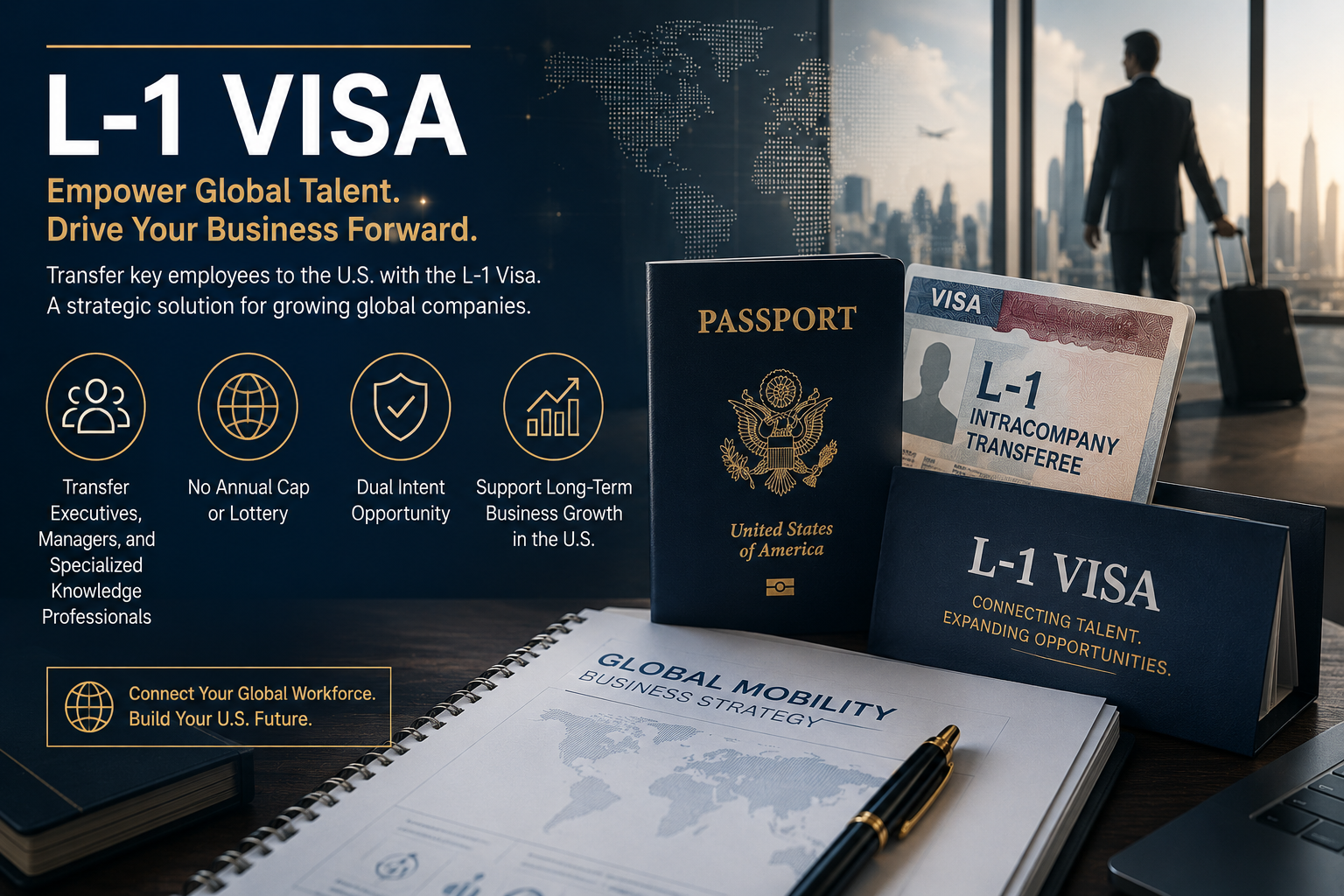
Explore the comprehensive guide on L-1 Visa Requirements for 2026, covering eligibility, documentation, costs, and timelines for multinational companies.
▸ Executive Summary
This guide provides a detailed overview of the L-1 visa requirements for 2026, focusing on eligibility criteria, documentation, and strategic considerations for multinational companies. It highlights the importance of understanding the qualifying relationships between entities, prior employment abroad, and the roles of employees both abroad and in the U.S. The article also addresses common mistakes that can lead to costly delays and the benefits of working with experienced immigration counsel.
Introduction
Understanding L-1 visa requirements in 2026 is not just a compliance matter for multinational companies looking to transfer key personnel to the United States, it is a strategic business decision. The L-1 visa remains one of the most powerful tools available to corporations seeking to relocate executives, managers, and specialized knowledge workers across borders. Yet many businesses lose weeks, sometimes months, to preventable procedural errors. This guide breaks down everything growing businesses need to know about the L-1 visa, from eligibility and documentation to costs and timelines.
What Is an L-1 Visa?
Before diving into requirements, it helps to clarify what the L-1 visa means and who it serves. The L-1 visa is a nonimmigrant visa under the nonimmigrant classification that allows international companies, including multinational organizations, to transfer employees from a foreign affiliate, subsidiary, branch, or parent company to a U.S.-based entity. It is designed specifically for intracompany transferees who hold qualifying roles and have been employed abroad for a sufficient period.
There are two distinct categories under L-1 visas:
- L-1A Visa, For executives and managers. This dual intent visa is valid for an initial stay of up to three years and can be renewed for a total of up to seven years, and serves as a common pathway to EB-1C green card sponsorship.
- L-1B Visa, For employees with specialized knowledge. Valid for an initial period and can be extended for a maximum of up to five years.
Understanding which category applies to your employee is the first critical decision in the process. Unlike many other work visas, the L-1 visa is not subject to an annual cap or lottery, making it a more predictable option for international companies needing to transfer employees.
Core L-1 Visa Requirements for 2026
Meeting L-1 visa requirements demands precision. Both the employee and the petitioning employer must meet specific eligibility criteria. USCIS scrutinizes every petition, and even minor documentation gaps can result in Requests for Evidence (RFEs) that add months to your timeline. Here are the foundational eligibility criteria:
1. Qualifying Relationship Between Entities
The U.S. company and the foreign employer must share a qualifying corporate relationship. Acceptable structures include:
- Parent company (foreign entity owns the U.S. company)
- Subsidiary (U.S. entity owns the foreign company)
- Affiliate (both are owned by the same parent)
- Branch office (same legal entity operating in multiple countries)
Businesses must provide organizational charts, ownership agreements, and financial records to establish this relationship clearly. Failure to document the corporate structure thoroughly is one of the most common causes of RFEs under current L-1 visa regulations.
2. Prior Employment Abroad
The transferee must have worked for the qualifying foreign entity for a continuous period of at least one year within the three years immediately preceding the U.S. entry petition. Employment must have been full-time and in a qualifying capacity.
3. Qualifying Role, Now and Then
The employee must have been employed abroad in an executive, managerial, or specialized knowledge capacity, and must be coming to the U.S. to work in a similar qualifying capacity. USCIS will evaluate both the prior role and the intended U.S. role independently.
Managerial or Executive Capacity involves:
- Directing the work of other professionals or managing a key function
- Exercising discretion over business operations at a senior level
- Having authority to hire, fire, or recommend personnel decisions
Specialized Knowledge involves:
- Proprietary knowledge of the company's products, services, or procedures
- Advanced expertise in the organization's methods or applications within the industry
Documenting specialized knowledge has become increasingly scrutinized in recent years, and immigration attorneys strongly recommend robust evidentiary packages including performance reviews, organizational charts, technical documentation, and letters from senior management.
New Office L-1 Petitions: Higher Stakes, Higher Scrutiny
If your company is opening a new U.S. office, the L-1 visa process adds another layer of complexity. Under new office provisions, the initial visa is granted for just one year, after which the company must demonstrate that the U.S. operation has grown sufficiently to support the executive or managerial position.
Key requirements for new office petitions include:
- A physical U.S. office space (lease agreements required)
- A credible business plan demonstrating the company's financial viability
- Evidence of sufficient capitalization to support U.S. operations
- Projected organizational structure for the next three years
Many companies underestimate the scrutiny applied at the one-year extension stage. Working with experienced immigration counsel from day one dramatically improves outcomes.
Common Mistakes That Cause Costly Delays
Even well-resourced companies run into avoidable problems with L-1 visa petitions. The most frequent issues our firm encounters include:
- Insufficient evidence of the qualifying relationship between the U.S. and foreign entities
- Vague job descriptions that fail to clearly establish executive, managerial, or specialized knowledge capacity
- Missing or inconsistent tax and payroll records for the foreign employer
- Failure to document the employee's decision-making authority in their prior role
- Underestimating the new office evidentiary burden at the extension stage
An RFE, a Request for Evidence from USCIS, can add 3 to 6 months to your timeline. A denial sets the process back even further and may require appeals or refiling. Prevention through expert preparation is always the better business decision.
Blanket L-1 Petitions: The Enterprise Solution
For large multinational corporations that regularly transfer employees to the U.S., the Blanket L-1 petition is a pre-approval process that enables companies to expedite the L-1 visa application process for qualified managers, executives, and specialized knowledge workers. Instead of filing an individual petition for each transferee, a blanket petition allows multiple employees to be covered under a single, company-wide petition with USCIS. Employees who are not covered by a blanket petition must go through the individual petition process, which involves independent filings with USCIS for each employee seeking an L-1 visa.
Requirements for a Blanket L-1 petition include:
- The U.S. entity must have been doing business for at least one year
- The organization must have three or more domestic and foreign branches, subsidiaries, or affiliates
- The company must meet certain threshold criteria (e.g., annual U.S. sales of $25 million or more, OR 1,000+ U.S. employees, OR 10 or more approved L-1 petitions in the past 12 months)
Once blanket approval is obtained, individual employees can be processed at consulates abroad, significantly accelerating deployment timelines for qualifying businesses. Employees who do not qualify under the blanket petition must file an individual petition with USCIS.
L-1 Visa Regulations: Staying Compliant in a Shifting Landscape
L-1 visa regulations have been subject to increased scrutiny over the past several years, and 2026 is no exception. USCIS continues to emphasize:
- Wage and hour compliance for transferred employees
- Site visit authority, USCIS officers may conduct unannounced visits to employer locations
- Third-party placement restrictions, L-1B employees cannot be placed at third-party worksites in ways that suggest they are employees of that third party rather than the petitioning company
Staying ahead of regulatory developments requires ongoing attention. Companies with a proactive relationship with experienced immigration counsel are far better positioned to adapt quickly and avoid compliance exposure.
Restrictions of the L-1 Visa
The L-1 visa is a powerful tool for multinational companies and foreign employers seeking to transfer key talent to the United States, but it comes with specific restrictions that must be carefully observed to maintain compliance and avoid costly setbacks.
One of the primary limitations is that the L-1 visa holder is authorized to work only for the same employer that sponsored their visa. This means employment is strictly limited to the qualifying U.S. entity with which the foreign company has a documented qualifying relationship. L-1 visa holders cannot accept employment with another company, nor can they work as independent contractors or take on side jobs. The visa is designed exclusively for intracompany transfers, ensuring that only those with specialized knowledge or those serving in a managerial or executive capacity are eligible to work in the U.S. under this nonimmigrant classification.
Duration of stay is another key restriction. L-1A visa holders, who are transferred in a managerial or executive position, may remain in the United States for up to seven years. L-1B visa holders, who are transferred based on specialized knowledge, are limited to a maximum stay of up to five years. Once these maximum periods are reached, the individual must depart the U.S. and remain outside the country for at least one continuous year before becoming eligible to apply for a new L-1 visa. This rule applies regardless of whether the employee is working for the same employer or a different qualifying company abroad.
The L-1 visa is also tied to the specific job and employer described in the original petition. If the visa holder’s job duties change significantly, or if they wish to transfer to a different employer, even within the same corporate group, a new L-1 petition must be filed and approved by U.S. Citizenship and Immigration Services (USCIS). This underscores the importance of maintaining the qualifying employment abroad and ensuring that the employee continues to serve in a managerial, executive, or specialized knowledge role throughout their stay.
Family members, including spouses and unmarried children under 21, may accompany the L-1 visa holder to the U.S. on L-2 dependent visas. While L-2 spouses are eligible to apply for employment authorization, they must first obtain an Employment Authorization Document (EAD) from USCIS before accepting employment. Unmarried children on L-2 visas are not eligible for employment authorization but may attend school in the U.S.
The application process itself imposes additional requirements. The petitioning employer must provide evidence of the qualifying relationship between the U.S. and foreign entities, proof of the employee’s qualifying employment abroad, and documentation supporting the employee’s managerial, executive, or specialized knowledge position. For new office L-1 petitions, the employer must also demonstrate sufficient physical premises and a credible plan to support the employee’s role in the U.S.
Premium processing is available for an additional fee, allowing employers to expedite the adjudication of their L-1 petitions. However, this service does not alter the underlying eligibility requirements or guarantee approval; all standard documentation and compliance obligations remain in effect.
In summary, while the L-1 visa offers significant advantages for multinational companies and their employees, strict adherence to its restrictions is essential. Employers and employees must ensure that all terms of employment, qualifying relationships, and documentation requirements are met throughout the duration of the visa. Consulting with experienced immigration services can help both the petitioning employer and the visa applicant navigate these complexities and maintain compliance in a dynamic regulatory environment.
Why Partner with an Experienced Immigration Law Firm?
The L-1 visa is a powerful instrument, but only when wielded correctly. The regulatory environment demands precision documentation, deep knowledge of USCIS adjudication patterns, and strategic case-building that goes beyond simply filling out forms. At , we provide comprehensive immigration services, including assistance with L-1 visa applications and compliance, ensuring every aspect of your case is managed with expertise.
Our firm brings decades of experience advising multinational corporations on intracompany transfer strategies. We understand that for your business, immigration is not an administrative task, it is a competitive advantage. We work alongside HR teams, general counsel, and C-suite executives to ensure that your global talent moves efficiently, compliantly, and on schedule.
Whether you are initiating your first L-1 petition, navigating a complex new office setup, or scaling with a blanket L petition across multiple business units, we are ready to build the right strategy for your organization.
Contact our team today for a confidential consultation. Let us help you transfer the talent that drives your business forward, without the delays, surprises, or compliance risks.
Frequently Asked Questions
Conclusion
The L-1 visa remains a vital tool for multinational companies seeking to transfer key personnel to the United States. By understanding the requirements and potential pitfalls, businesses can leverage this visa category to their advantage. Working with experienced immigration counsel ensures compliance and strategic alignment with business goals. As regulations continue to evolve, staying informed and prepared is essential for success in global talent mobility.
This article is provided for informational purposes only and does not constitute legal advice. Immigration law is complex and fact-specific. Please consult a licensed immigration attorney regarding your individual circumstances.
Latest News
-
 15 Oct 2026
What Should Employees and Employers Do When PERM Applications Are Suspended?
-
 02 Oct 2026
EB-5 Filing Fees Nearly Double: What Investors Must Know Before November 30, 2026
-
 29 Sep 2026
E-1 Visa Guide for Companies and Entrepreneurs
-
 19 Sep 2026
US Immigration Solutions for Business: E-2, EB-2 NIW, and EB-5
-
 17 Sep 2026
Birthright Citizenship and Green Card Rules for Children of Foreign Government Employees