
Blog
What the Decision Means for Immigrant Families: Supreme Court Reaffirms Birthright Citizenship
What the Decision Means for Immigrant Families: Supreme Court Reaffirms Birthright Citizenship
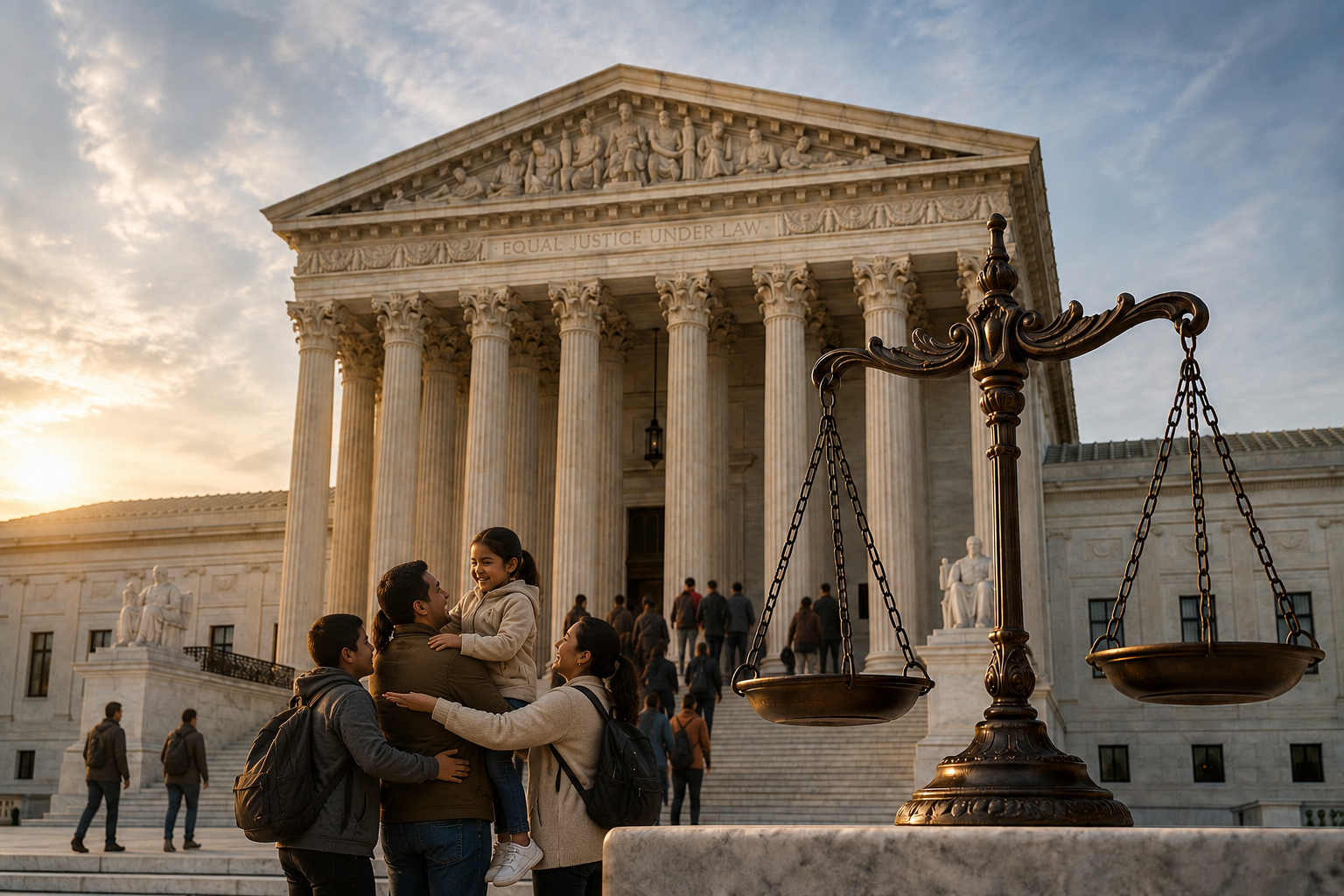
Explore the implications of the Supreme Court's decision reaffirming birthright citizenship for immigrant families in the United States.
▸ Executive Summary
The U.S. Supreme Court has reaffirmed the principle of birthright citizenship, ensuring that children born in the United States are granted citizenship regardless of their parents' immigration status. This decision provides clarity amidst recent immigration policy changes and underscores the constitutional protections of the Fourteenth Amendment.
Birthright Citizenship is a fundamental constitutional principle that grants U.S. citizenship to nearly every child born in the United States, regardless of where their parents come from. The U.S. Supreme Court’s recent decision on Birthright Citizenship reaffirms this long-standing rule.
President Donald Trump sought to limit birthright citizenship through Executive Order 14160. However, the Supreme Court issued a landmark decision addressing whether that executive order was lawful. In Trump v. Barbara, the Court resolved a long-standing constitutional question: Can a President unilaterally change the rules governing Birthright Citizenship through an executive order?
Foreign nationals, families, students, and anyone navigating the complexities of the U.S. immigration system have faced significant uncertainty due to recent immigration policies. This decision provides much-needed clarity during a challenging time.
This article explains what the Supreme Court decided. It also examines how the Citizenship Clause of the Fourteenth Amendment and the Court's decision in United States v. Wong Kim Ark continue to protect Birthright Citizenship. Finally, it explains what this ruling means for families whose children are born in the United States.
What Started It All: Executive Order 14160
President Donald Trump sought to limit U.S. citizenship for certain children born in the United States through Executive Order 14160. The order directed federal agencies to stop automatically recognizing these children as U.S. citizens, even if they were born in the United States.
The executive order faced immediate legal challenges from states, civil rights organizations, immigrant advocacy groups, and families who would be directly affected. Opponents argued that the order violated the Citizenship Clause of the Fourteenth Amendment and conflicted with more than a century of U.S. Supreme Court precedent protecting Birthright Citizenship.
Ultimately, the dispute reached the U.S. Supreme Court in Trump v. Barbara.
The Supreme Court's Birthright Citizenship Decision
The Supreme Court made one point unmistakably clear: A President does not have the authority to change the rules governing Birthright Citizenship through an executive order. According to the majority opinion, the Constitution cannot be altered unilaterally by the President. The Citizenship Clause remains the constitutional guarantee that individuals born in the United States are U.S. citizens.
The Court made clear that an executive order cannot redefine what it means to be a U.S. citizen. Any fundamental change to Birthright Citizenship would require a constitutional amendment—not a presidential executive order.
The Fourteenth Amendment Remains in Effect
The Citizenship Clause of the Fourteenth Amendment has been in effect since 1868. It provides that all persons born or naturalized in the United States, and subject to its jurisdiction, are U.S. citizens. This fundamental constitutional guarantee of U.S. citizenship has remained in force for more than 150 years. In practical terms, it means that children born in the United States automatically acquire U.S. citizenship at birth.
The Supreme Court's decision makes it clear that children born in the United States remain U.S. citizens regardless of their parents' immigration status.
United States v. Wong Kim Ark: The Cornerstone of American Citizenship Law
One of the most important authorities relied upon by the Supreme Court was its landmark 1898 decision in United States v. Wong Kim Ark.
In that historic case, the Court held that a child born in the United States is a U.S. citizen at birth under the Fourteenth Amendment, regardless of the citizenship or immigration status of the child's parents.
For more than a century, this decision has been recognized as the leading constitutional precedent establishing the principle of Birthright Citizenship.
In Trump v. Barbara, the Supreme Court expressly reaffirmed that the Wong Kim Ark precedent remains controlling law. The Court once again made clear that Birthright Citizenship cannot be restricted through a presidential executive order and that this constitutional guarantee is not subject to the discretion of the Executive Branch.
This decision strongly reaffirms that the citizenship of children born in the United States is based directly on the Fourteenth Amendment—not on changing political priorities or executive policy.
What the Supreme Court's Decision Means for Immigrant Families
As a result of the Supreme Court's decision, children born in the United States will continue to acquire Birthright Citizenship regardless of their parents' immigration status.
This protection also applies to children born in the United States whose parents are:
- undocumented immigrants,
- asylum applicants,
- in the United States on student visas,
- in the United States on employment-based or other temporary visas,
- in removal (deportation) proceedings, or
- applying to adjust or change their immigration status.
As a result, federal agencies will continue to issue U.S. passports, Social Security numbers, and provide all other citizenship-related benefits and documentation to these children, just as they have done for decades.
In short, the Supreme Court's decision does not change the long-standing application of Birthright Citizenship. Instead, it reaffirms that this constitutional right cannot be restricted by a presidential executive order.
What This Decision Does Not Change
The Supreme Court's decision does not automatically change a parent's immigration status simply because their child is a U.S. citizen.
Parents who wish to remain in the United States, obtain lawful permanent residence (a Green Card), or become U.S. citizens must still satisfy all applicable requirements under U.S. immigration law.
Likewise, this decision does not eliminate immigration court proceedings, visa requirements, removal proceedings, or any other immigration obligations that may apply to parents.
In other words, having a child who is a U.S. citizen does not automatically provide immigration benefits or legal status to the parents. They must continue to comply with U.S. immigration laws and follow the same legal procedures that apply to everyone else.
Why This Supreme Court Decision Matters Beyond Immigration Law
At first glance, this case may appear to be only about citizenship. However, the Supreme Court's decision reaffirms several fundamental constitutional principles, including:
- the protection of individual constitutional rights,
- the separation of powers,
- the constitutional limits on executive authority,
- the importance of adhering to long-established constitutional law, and
- respect for Supreme Court precedent.
These principles extend far beyond immigration law and have broad implications for the relationship between the Executive Branch and the U.S. Constitution.
Why You Still Need an Experienced Immigration Attorney
The reality is that every immigration case is unique. Families often need experienced legal guidance to navigate the complexities of U.S. immigration law. With so many different immigration options and procedures available, it is easy to make mistakes that may have serious and costly consequences.
An experienced immigration attorney or law firm can assist with:
- adjustment of status,
- family-based immigration petitions,
- employment-based immigration,
- asylum applications,
- waivers,
- consular processing,
- obtaining lawful permanent residence (a Green Card),
- removal defense, and
- deportation (removal) proceedings.
At Akalan Law, we understand that immigration decisions affect not only individuals but entire families. Whether you have questions about Birthright Citizenship, family-based immigration, or any other area of U.S. immigration law, we are here to provide trusted legal guidance. Our experienced immigration attorneys are committed to assisting you throughout every stage of the immigration process.
If you would like to understand how current U.S. immigration laws may affect your family or your future immigration options, our immigration law team is ready to evaluate your situation and discuss the legal strategies that may be available to you.
Frequently Asked Questions
Conclusion
The Supreme Court's decision to reaffirm birthright citizenship is a significant victory for immigrant families in the United States. It ensures that children born on U.S. soil will continue to be recognized as citizens, regardless of their parents' immigration status. This decision not only upholds a fundamental constitutional principle but also provides clarity and stability in the face of changing immigration policies.
This article is provided for informational purposes only and does not constitute legal advice. Immigration law is complex and fact-specific. Please consult a licensed immigration attorney regarding your individual circumstances.
Latest News
-
 02 Oct 2026
EB-5 Filing Fees Nearly Double: What Investors Must Know Before November 30, 2026
-
 29 Sep 2026
E-1 Visa Guide for Companies and Entrepreneurs
-
 19 Sep 2026
US Immigration Solutions for Business: E-2, EB-2 NIW, and EB-5
-
 17 Sep 2026
Birthright Citizenship and Green Card Rules for Children of Foreign Government Employees
-
 14 Sep 2026
DHS Proposes Eliminating the 60-Day Grace Period for Foreign Workers Whose Employment Ends