
Blog
Can USCIS Deny Adjustment of Status Even If Youre Eligible?
Can USCIS Deny Adjustment of Status Even If Youre Eligible?
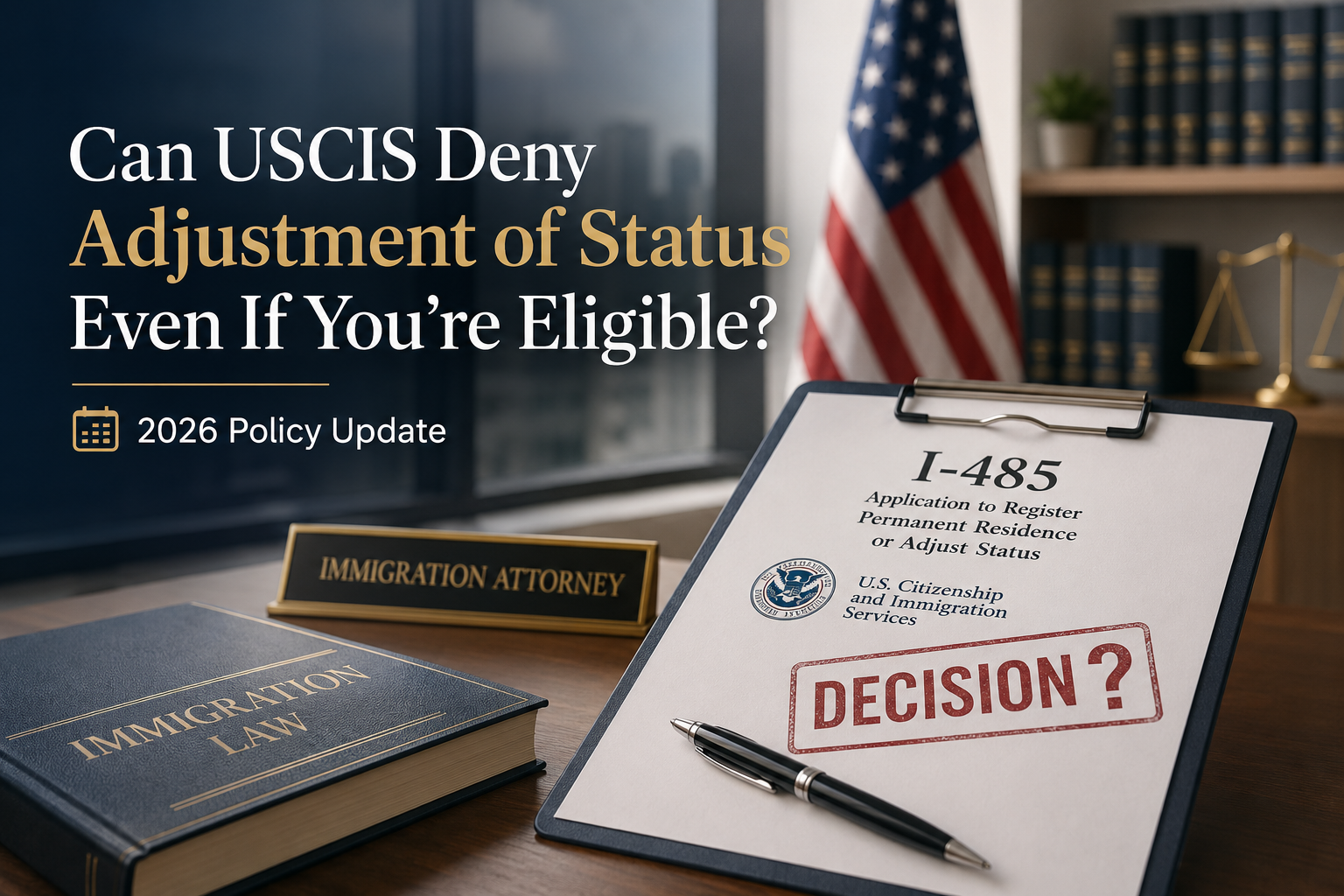
Explore the 2026 USCIS policy update on adjustment of status. Learn how eligibility doesn't guarantee approval and what factors USCIS considers.
▸ Executive Summary
The 2026 USCIS policy update has introduced significant changes to the adjustment of status process. Even if applicants meet all eligibility requirements, USCIS now exercises greater discretion, treating the process as an extraordinary form of relief. This article explores the implications of this policy change, the factors USCIS considers, and how applicants can strengthen their applications.
The short answer is Yes - USCIS can still deny an adjustment of status even if you meet all the technical requirements. And that's a big change in how USCIS is handling applications from 2026 onwards.
For years, many people have assumed that if you had an approved immigration petition, were in good standing, and had no skeletons in your closet, a green card was all but a done deal through the adjustment of status process. And in most cases, that assumption was more or less spot on. But not anymore.
The new USCIS Policy Memorandum - PM-602-0199 - flipped that script overnight. Suddenly, USCIS is treating adjustment of status as a special favor, rather than the straightforward process we all thought it was. They even refer to it as an "extraordinary form of relief and administrative grace".
As immigration experts, we believe this policy change is something you need to pay close attention to. Although the actual law hasn't changed one bit, the way USCIS officers are using their discretion has. So if you're considering applying for an adjustment of status, be warned: your application needs to be much stronger than ever before.
What follows is a detailed guide to help you understand what this policy change means for you, who it's most likely to affect, and what you can do to stay ahead of the game.
What is Adjustment of Status?
We get asked this all the time: What is adjustment of status?
Put simply, adjustment of status lets eligible individuals apply for a permanent green card without leaving the US. Instead of going to an immigrant visa interview at a US consulate in some other country, you can do the whole thing right here in the States.
Most adjustment of status applicants start by filing the relevant forms. The main one is the I-485 Application to Register Permanent Residence or Adjust Status. And there are several ways you might qualify:
- Through your employer
- Through a family member
- As an asylum seeker or refugee
- Under certain humanitarian programs
- Or any other immigration pathways that are currently open
The key point here is that, when it comes to adjustment of status, USCIS officers now have even more flexibility to decide whether to approve your application. So, if you meet the eligibility requirements on paper, you'll also need to demonstrate why you deserve a favourable outcome.
As adjustment of status lawyers, we're now helping our clients to be better prepared with supporting evidence that highlights their positive immigration history, their job record, family ties and contributions to the US.
Why Did USCIS Change Its Policy in 2026?
The new policy - reflected in the 2026 policy memorandum - is a significant game-changer.
What USCIS has done is not actually changed the Immigration and Nationality Act. It just changed how they approach discretionary decisions. So now, before approving an adjustment of status application, officers will be weighing up both the positive and negative factors.
For example, they might be looking at things like:
- Your immigration history - any past mistakes?
- How well you've followed the rules on previous visas
- Ties to family and friends in the US
- Your work history
- The economic benefits you bring to the country
- Whether your application shows honesty and integrity
- And other relevant factors
And here's the thing: just having a clean slate is not enough on its own. They need good reasons to approve your application, and that means your application needs to be all the more compelling.
As a side effect of this change, USCIS is also becoming more likely to send cases to US consulates for visa approval. And for people who entered the US on a temporary visa, they can expect even closer scrutiny.
Filing an Adjustment of Status Application
Preparing an adjustment of status application is now a much more complex and demanding process.
What this means is that your application needs to paint a complete and consistent picture of your life and immigration history. In short, you need to tell a story that makes sense.
First off, take a close look at your immigration history. No matter how small, inconsistencies may now be seen as a major issue.
Second, supporting documentation is now more important than ever. Think things like employment records, tax returns, community involvement, family relationships. The more you can provide, the stronger your application will be.
Third, have your story ready in case USCIS has any questions - and you can be sure they will!
For employment-based applicants, maintaining a valid H-1B or L-1 visa is still a plus, but having a valid visa alone no longer guarantees approval.
If you entered the US on an F-1, B-1/B-2 or J-1 visa, you can expect extra scrutiny. USCIS will be checking whether you intended to immigrate when you first entered.
As immigration lawyers, we think its smarter to build a strong case before filing, rather than trying to patch up any mistakes or inconsistencies after an RFE.
Taking the time to do this properly is often the difference between a smooth and trouble-free application process, and unnecessary delays and complications down the line
Adjustment of Status Processing Time
Another question we get asked all the time is: how long does an adjustment of status take?
Regrettably the answer is not a simple one.
There are a whole range of factors that can influence how long an I-485 adjustment of status case may take - factors like the type of visa catagory, USCIS workload, background and security checks, interview requirements, requests for evidence and so on.
And with the new discretionary review process, applications may now take even longer to process than before.Although faster processing isnt always on the cards, you can make a big difference just by not getting in your own way.
For instance, making sure you submit all the documentation at the same time, responding to any USCIS requests that come your way as quickly as you can, and filling out your application forms with care can all help avoid unnecessary delays.
But whats crucial to keep in mind is that every case is different - so for goodness sake dont compare yourself to someone elses timeline.
Instead of worrying about how long its taking, just focus on getting everything in order right from the start.
Who Faces the Highest Risk?
Not everyone is on the radar for as much scrutiny as others.
According to the new guidance, people who came in with single-intent visas might have a tougher time than others.
These visa categories include:
- F-1 students - they might come in for a bit of a grilling.
- B-1/B-2 visitors - same here.
- J-1 exchange visitors - officers may question whether they were always planning to make the US their home.
If you filed pretty soon after you entered the country, officers might come back and ask some extra questions.
On the other hand, H-1B and L-1 visa holders are in a pretty solid position because these categories recognise dual intent.
Still, its worth remembering that discretion now plays a much bigger part in the decision-making process than it used to.
Even if youve got a squeaky-clean record, you should still be prepared to show why allowing you to stay permanently is in everyone's best interests.
Frequently Asked Questions
Conclusion
The answer to the question is clear. USCIS can still deny you even if you are eligible. Fortunately, that does not mean everything is lost.
All it means is that preparation has become even more crucial than ever. If you send in a strong adjustment of status application, you should be able to establish that you meet the requirements and show why USCIS should use their discretion in your favour.
If you are planning to file Form I-485, you are dealing with a Request for Evidence, or you are trying to decide between adjustment of status and consular processing, our immigration lawyers are here to help.
Every case is different so we will come up with a strategy that is tailored to your needs. Get in touch with our office today to discuss your options and boost your chances of a successful application.
This article is provided for informational purposes only and does not constitute legal advice. Immigration law is complex and fact-specific. Please consult a licensed immigration attorney regarding your individual circumstances.
Latest News
-
 15 Oct 2026
What Should Employees and Employers Do When PERM Applications Are Suspended?
-
 02 Oct 2026
EB-5 Filing Fees Nearly Double: What Investors Must Know Before November 30, 2026
-
 29 Sep 2026
E-1 Visa Guide for Companies and Entrepreneurs
-
 19 Sep 2026
US Immigration Solutions for Business: E-2, EB-2 NIW, and EB-5
-
 17 Sep 2026
Birthright Citizenship and Green Card Rules for Children of Foreign Government Employees