
Blog
Family Reunification Through Marriage for U.S. Citizens and Green Card Holders
Family Reunification Through Marriage for U.S. Citizens and Green Card Holders
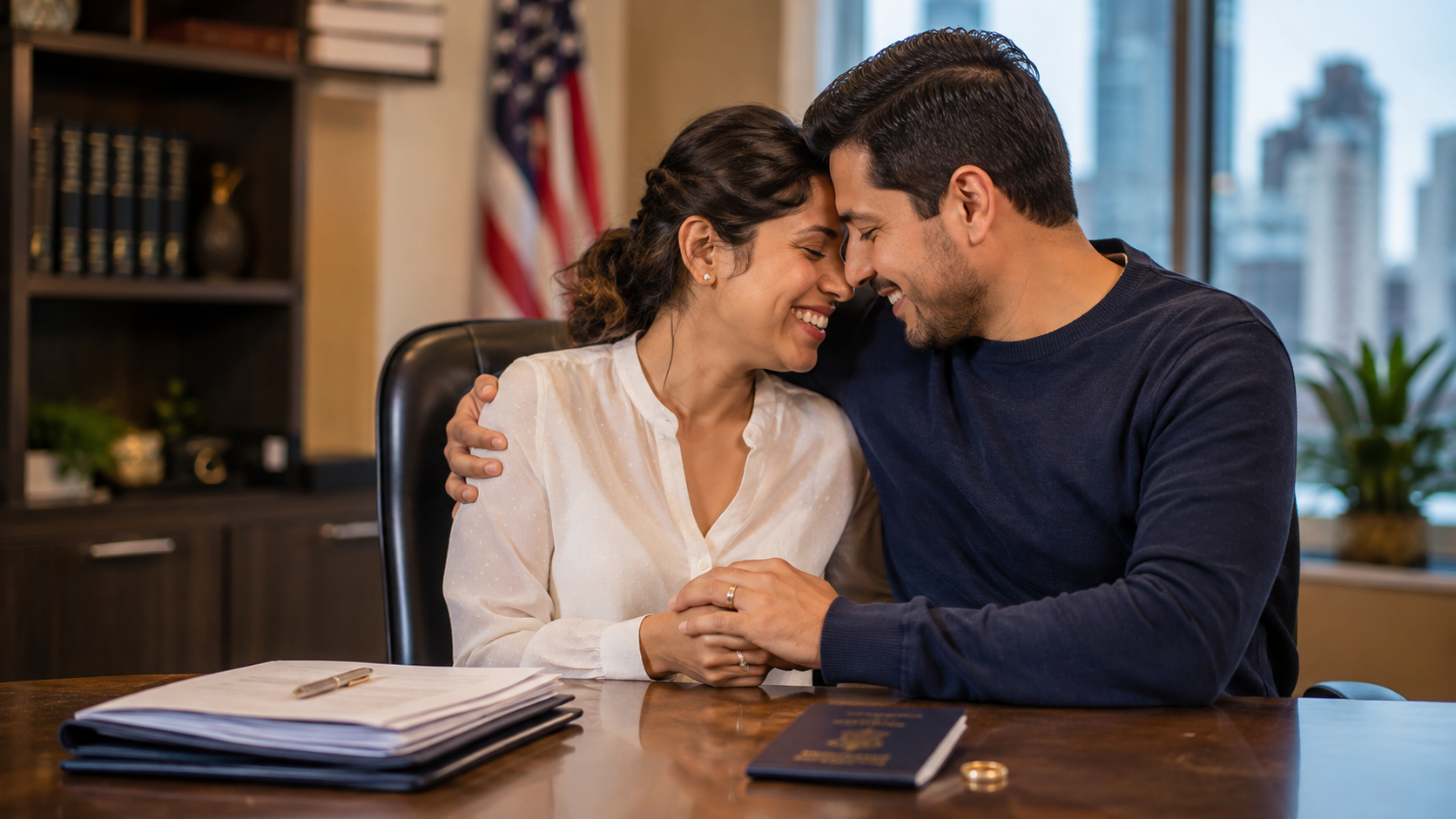
Learn about the process of family reunification through marriage for U.S. citizens and Green Card holders, including filing Form I-130, proving a bona fide marriage, and navigating the consular process.
▸ Executive Summary
This article provides a comprehensive guide on family reunification through marriage for U.S. citizens and Green Card holders. It covers the process of filing Form I-130, the importance of proving a bona fide marriage, and the steps involved in consular processing. The guide also discusses the differences between CR1 and IR1 visas, the role of the National Visa Center, and common mistakes to avoid in spouse immigration cases.
Marriage-based family reunification, in simple terms, allows married couples who are living in different countries to build a life together in the United States. The spouse living in the United States may be either a U.S. citizen or a Green Card holder. That spouse may initiate the immigration process so that the foreign national spouse can come to the United States and obtain lawful permanent resident status. For many couples, the process begins with Form I-130, Petition for Alien Relative, and continues through the National Visa Center (NVC) and a U.S. embassy or consulate abroad.
A spouse case may look simple because the qualifying relationship is a marriage, but the government does not approve a case merely because a marriage certificate exists. The petitioner must establish a legally valid marriage, the couple must show that the marriage is genuine, the financial sponsorship rules must be satisfied, and the foreign spouse must be admissible to the United States. Mistakes at any of these stages can lead to delays, requests for additional evidence, or denial.
This guide focuses on the spouse immigration process when the foreign spouse is outside the United States. It explains the I-130 spouse petition, CR1 and IR1 immigrant visas, the F2A category for spouses of lawful permanent residents, NVC processing, financial sponsorship, the consular interview, and what happens after the immigrant spouse enters the United States.
1. Who Can File an I-130 Spouse Petition?
A U.S. citizen or lawful permanent resident (Green Card holder) may file Form I-130 for a qualifying foreign spouse. The legal category and timing, however, are different depending on the petitioner’s immigration status.
A spouse of a U.S. citizen is an “immediate relative.” Immediate-relative immigrant visas are not subject to an annual numerical quota. After USCIS approves the I-130 and the remaining requirements are completed, the case can move forward without waiting for a family-preference visa number to become available.
A spouse of a lawful permanent resident generally falls within the F2A family-preference category. F2A cases are subject to annual visa limits and the Department of State’s monthly Visa Bulletin. Because Visa Bulletin dates can advance, remain unchanged, or retrogress, Green Card holders sponsoring a spouse should monitor visa availability throughout the case.
If a lawful permanent resident becomes a U.S. citizen while the spouse case is pending, the case may generally be upgraded from the F2A category to the immediate-relative category. The appropriate agency should be notified so the case can be handled under the petitioner’s new status.
2. What Does Form I-130 Actually Do?
Form I-130 is the petition that asks U.S. Citizenship and Immigration Services (USCIS) to recognize the qualifying family relationship between the petitioner and the foreign spouse. Approval of the I-130 is important, but it is not the same as approval of a Green Card or immigrant visa.
An approved I-130 does not by itself give the foreign spouse permission to enter the United States, work in the United States, or live in the United States permanently. It establishes the relationship that supports the later immigrant visa process.
For a spouse beneficiary, Form I-130A, Supplemental Information for Spouse Beneficiary, must also be completed and submitted with the I-130. If the beneficiary lives abroad, the I-130A is still required, although USCIS instructions provide that an overseas spouse does not need to sign that form.
3. What Must Be Proven in a Marriage-Based I-130 Case?
A strong spouse petition usually proves three separate points: the petitioner has the required U.S. immigration status, the marriage is legally valid, and the marriage was entered into in good faith rather than primarily to obtain an immigration benefit.
The petitioner normally submits evidence of U.S. citizenship or lawful permanent residence, the civil marriage certificate, and documents showing that all prior marriages of either spouse legally ended before the current marriage took place.
The couple should also submit evidence of a bona fide marital relationship. USCIS specifically recognizes evidence such as joint ownership of property, a shared lease or residence, combined financial resources, birth certificates of children born to the couple, affidavits from people with personal knowledge of the relationship, and other evidence showing an ongoing marital union.
4. What Is Bona Fide Marriage Evidence?
“Bona fide marriage” means that the couple intended to build a real life together when they married. Immigration officers look at the totality of the evidence rather than relying on a single document. The strongest files usually tell a consistent story over time.
Depending on the couple’s circumstances, useful evidence may include:
- Joint bank or credit-card statements showing real shared financial activity.
- A lease, mortgage, property deed, or other evidence of a shared residence.
- Health, life, auto, or other insurance documents listing one spouse as the other spouse’s beneficiary or household member.
- Tax records showing the marital relationship where applicable.
- Travel records, hotel reservations, airline tickets, passport stamps, and visits documenting time spent together.
- Photographs from different periods and settings, including family events and ordinary daily life.
- Messages, call records, or other communication history, especially for couples who have lived apart because of work, immigration processing, or international travel restrictions.
- Evidence of children, shared responsibilities, family celebrations, or other long-term commitments.
- Detailed affidavits from relatives or friends who know the couple and can explain how they know the relationship is genuine.
Couples do not need to manufacture joint documents that do not fit their real circumstances. A recently married international couple may naturally have less shared financial history than a couple that has lived together for years. The goal is to provide credible evidence that matches the actual relationship and explains any unusual facts rather than leaving important gaps unanswered.
5. What Happens After USCIS Approves the I-130?
For a spouse living outside the United States, an approved I-130 is generally sent to the Department of State’s National Visa Center. The NVC creates the immigrant visa case and provides access to the Consular Electronic Application Center (CEAC).
The NVC stage is more than an administrative transfer. The petitioner and beneficiary must complete several required steps before the case can be considered ready for a consular interview.
The process commonly includes:
- Paying the applicable immigrant visa and Affidavit of Support processing fees.
- Completing Form DS-260, Immigrant Visa and Alien Registration Application.
- Submitting Form I-864, Affidavit of Support, and the required financial evidence.
- Uploading the beneficiary’s required civil documents through CEAC.
- Responding to any NVC request for a corrected or missing document.
- Waiting for the case to become documentarily complete and, when a visa number is required, available for final action.
- Preparing for the medical examination and immigrant visa interview at the designated U.S. embassy or consulate.
NVC document requirements are country-specific. Birth certificates, marriage certificates, divorce decrees, police certificates, and translations must comply with Department of State rules for the country where the document was issued. Applicants should not assume that a document commonly accepted for local purposes will automatically satisfy immigrant visa requirements.
6. The Affidavit of Support: Why Form I-864 Matters
Most marriage-based immigrant visa cases require Form I-864, Affidavit of Support Under Section 213A of the Immigration and Nationality Act. This is not merely a letter stating that the petitioner intends to help the spouse. It is a legally enforceable sponsorship commitment.
The petitioner is normally required to submit an I-864 even if a joint sponsor is needed. The sponsor generally must show sufficient household income or qualifying assets under the applicable poverty guidelines. If the petitioner does not meet the financial threshold, a qualifying joint sponsor may be able to submit a separate I-864.
The petitioner must also satisfy the U.S. domicile requirement. This issue is especially important when the U.S. citizen or Green Card holder has been living abroad with the foreign spouse. A petitioner who is temporarily abroad may need to show that U.S. domicile has been maintained, or that concrete steps are being taken to re-establish domicile in the United States no later than the immigrant spouse’s admission.
Financial sponsorship errors are a common source of NVC delay. Household size, tax filing history, current income, use of assets, joint-sponsor eligibility, and domicile should be reviewed carefully before the documents are submitted.
7. CR1 vs. IR1: What Is the Difference?
A spouse of a U.S. citizen who completes consular processing may receive either a CR1 or IR1 immigrant visa classification. The difference depends on how long the couple has been married when the foreign spouse becomes a permanent resident.
If the marriage is less than two years old when the spouse is admitted to the United States as a permanent resident, the spouse generally receives conditional permanent resident status. This is commonly associated with the CR1 classification. Conditional residence is valid for two years.
If the marriage is at least two years old when permanent residence is granted through admission, the spouse generally receives non-conditional permanent residence, commonly associated with the IR1 classification.
A conditional resident normally must later file Form I-751, Petition to Remove Conditions on Residence. In a typical joint filing, the petition is filed during the 90-day period before the second anniversary of obtaining conditional resident status. Couples should continue preserving evidence of their shared marital life after the immigrant spouse enters the United States because USCIS may again evaluate whether the marriage was entered into in good faith.
8. How Is the Process Different for a Green Card Holder’s Spouse?
When the petitioner is a lawful permanent resident rather than a U.S. citizen, the spouse is generally classified in the F2A category. The I-130 filing process is similar, but visa availability becomes an additional issue.
The priority date is generally the date USCIS properly receives the I-130 petition. The Department of State publishes a Visa Bulletin every month. A case can proceed to certain stages only when the relevant chart permits it, and final immigrant visa issuance requires a visa number to be available under the applicable Final Action Date.
This distinction can be important even when the I-130 itself has already been approved. Petition approval and visa availability are separate concepts. A Green Card holder therefore should not assume that an approved I-130 means the spouse can immediately receive an immigrant visa.
9. The Consular Interview: What Should the Couple Expect?
Before the immigrant visa interview, the foreign spouse must complete the required medical examination with an authorized panel physician and follow the specific instructions of the embassy or consulate handling the case.
At the interview, a consular officer may review the legal validity of the marriage, the history of the relationship, prior marriages, immigration history, criminal history, financial sponsorship, civil documents, and any potential ground of inadmissibility. The officer may also ask for updated relationship evidence, especially if a significant amount of time has passed since the I-130 was filed.
The beneficiary should answer questions truthfully and consistently. If the case contains a complicated immigration history, prior visa refusal, unlawful presence, removal order, criminal matter, alleged misrepresentation, or another potential inadmissibility issue, the legal consequences should be evaluated before the interview rather than after an unexpected refusal.
10. What Happens After the Immigrant Visa Is Approved?
After visa issuance, the spouse may travel to the United States during the visa’s validity period. The immigrant should also pay the USCIS Immigrant Fee when required. USCIS uses that fee to process the immigrant’s admission information and produce the Permanent Resident Card.
When the spouse is admitted to the United States with the immigrant visa, the spouse becomes a lawful permanent resident. The physical Green Card is generally produced and mailed after admission and payment of the required immigrant fee.
The date of admission is also important for conditional residents because it starts the two-year conditional residence period and determines the future I-751 filing window.
11. Common Mistakes in Spouse Immigration Cases
Many spouse cases are delayed not because the marriage is invalid, but because the file is incomplete, inconsistent, or poorly prepared. Common problems include:
- Submitting only a marriage certificate with little or no evidence of a genuine marital relationship.
- Failing to disclose a prior marriage, divorce, immigration filing, arrest, visa refusal, or prior name.
- Using dates and addresses that conflict across the I-130, I-130A, DS-260, civil documents, and prior immigration records.
- Submitting the wrong civil document or an unacceptable version of a birth, marriage, divorce, or police certificate.
- Providing an incomplete I-864 or calculating household size incorrectly.
- Assuming a joint sponsor eliminates the petitioner’s own I-864 or domicile obligations.
- Failing to update USCIS or NVC after the petitioner naturalizes, changes address, or experiences another material change.
- Waiting until the consular interview to investigate a possible inadmissibility problem.
- For conditional residents, forgetting the future I-751 requirement after entering the United States.
Frequently Asked Questions
Conclusion
Bringing a spouse to the United States through family reunification involves more than filing Form I-130. A successful case requires a legally valid marriage, persuasive evidence of a bona fide relationship, accurate immigration and civil records, proper financial sponsorship, completion of NVC requirements, and a careful consular process.
For U.S. citizens, a spouse is an immediate relative and is not subject to an annual immigrant visa quota. For Green Card holders, the spouse generally proceeds through the F2A category and visa availability must be monitored. After approval, couples should also understand whether the immigrant spouse will receive conditional residence and whether Form I-751 will later be required.
Because every family’s history is different, a spouse immigration strategy should be based on the couple’s actual facts rather than a generic checklist. Early review of relationship evidence, financial sponsorship, prior immigration history, and potential inadmissibility issues can reduce avoidable delays and help the couple move through the process with greater clarity.
This article is provided for informational purposes only and does not constitute legal advice. Immigration law is complex and fact-specific. Please consult a licensed immigration attorney regarding your individual circumstances.
Latest News
-
 02 Oct 2026
EB-5 Filing Fees Nearly Double: What Investors Must Know Before November 30, 2026
-
 29 Sep 2026
E-1 Visa Guide for Companies and Entrepreneurs
-
 19 Sep 2026
US Immigration Solutions for Business: E-2, EB-2 NIW, and EB-5
-
 17 Sep 2026
Birthright Citizenship and Green Card Rules for Children of Foreign Government Employees
-
 14 Sep 2026
DHS Proposes Eliminating the 60-Day Grace Period for Foreign Workers Whose Employment Ends