
Blog
U.S. Temporarily Pauses Immigrant Visa Applications Worldwide
U.S. Temporarily Pauses Immigrant Visa Applications Worldwide
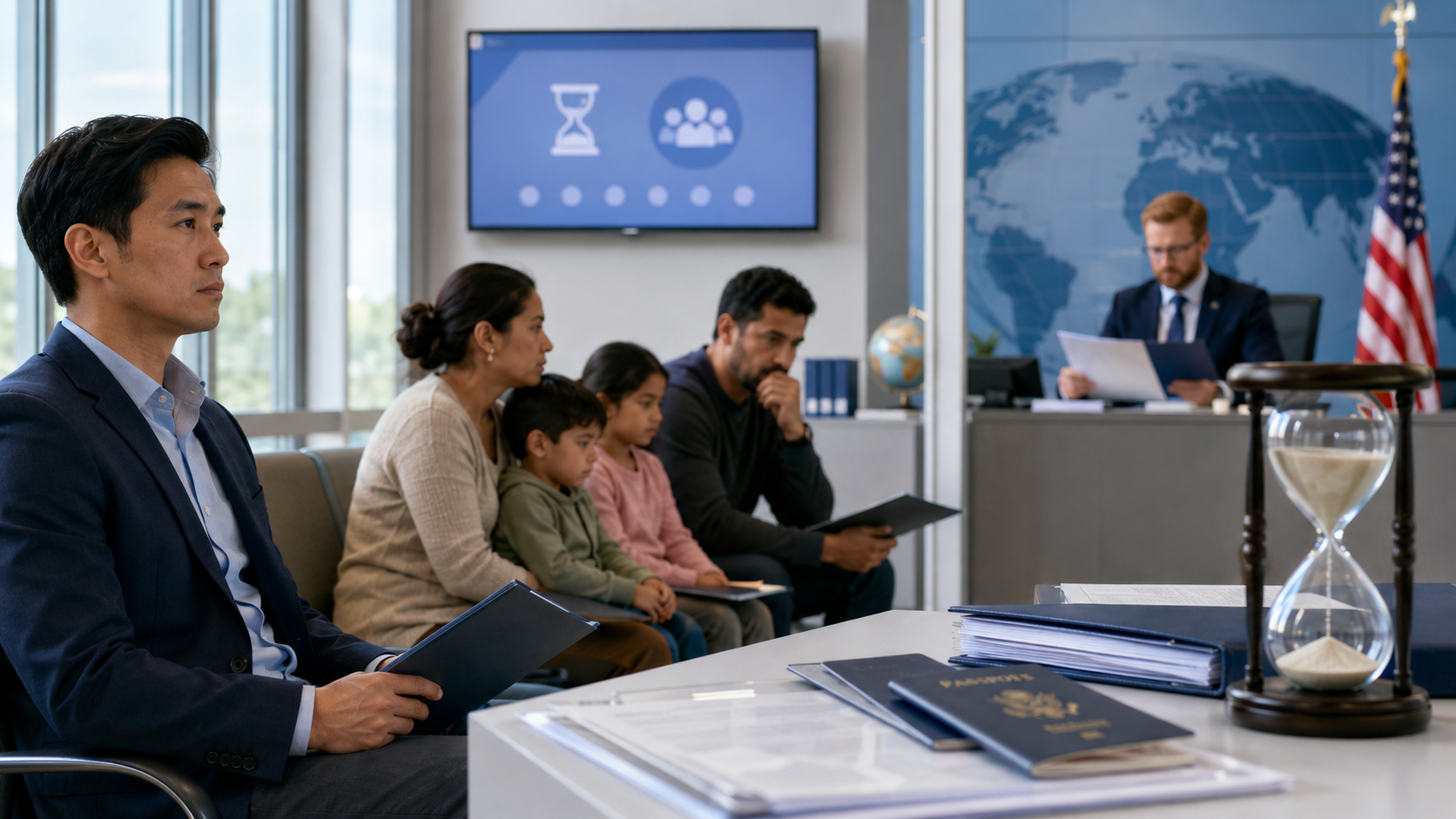
Explore the recent changes in U.S. immigrant visa applications, including temporary delays due to new training programs at U.S. embassies and consulates worldwide.
▸ Executive Summary
The U.S. Department of State has temporarily paused immigrant visa interviews worldwide to conduct a training program for consular officers. This training focuses on public charge assessments, affecting the scheduling of interviews but not the processing of all immigrant visa applications. The article explores the implications of these changes and the differences between consular processing and adjustment of status within the U.S.
A development has emerged that affects immigrant visa interviews worldwide. On August 25, 2026, a spokesperson for the U.S. Department of State told Reuters that the Department had launched a training program during August at U.S. embassies and consulates around the world. According to Reuters, the purpose of the training is to ensure that applicants are evaluated with consideration given to, among other factors, whether they may become dependent on public benefits in the United States.
This training is also affecting the scheduling of immigrant visa interviews at U.S. embassies and consulates. However, this does not mean that all immigrant visa applications have been canceled or permanently suspended.
The current development primarily involves the temporary delay of immigrant visa interviews while consular officers receive additional training.
This article explains the recent changes to interview scheduling, the Department of State’s training focused on public charge assessments, and how immigrant visa processing at U.S. consulates differs from the adjustment of status process inside the United States.
When Did the Department of State Announce This Change?
A U.S. Department of State spokesperson confirmed the development to Reuters on August 25, 2026. According to Reuters, the Department began a worldwide training program at U.S. embassies and consulates during August to help visa officers conduct more complete and consistent reviews of visa applicants, including reviews related to possible future dependence on public benefits.
Reuters later clarified its report to make clear that the temporary pause concerned immigrant visa interviews, rather than all types of U.S. visa interviews. The Reuters report carries a Washington date line of August 25, 2026, and was updated online on August 26, 2026.
There is also an important source distinction. As of August 28, 2026, the Department of State does not appear to have published a separate written announcement on its own website specifically describing the August 25 worldwide interview rescheduling. For that reason, the most accurate wording is that the Department of State confirmed the development to Reuters on August 25, 2026.
Immigrant Visa Applications Have Not All Been Canceled
An immigrant visa application and an immigrant visa interview are not the same thing. Current information does not show that the United States has canceled every pending immigrant visa application or prohibited people from filing new immigrant visa applications.
Instead, the Department of State has adjusted interview schedules at U.S. embassies and consulates to allow consular officers to complete the new training. For this reason, saying that “the United States stopped all immigrant visa applications” would be too broad. A more accurate description is that the Department of State is temporarily delaying or rescheduling immigrant visa interviews worldwide while consular officers receive additional training.
The Department has also not announced a firm date when all immigrant visa interview schedules will return to normal.
Who May Be Affected by the Temporary Immigrant Visa Interview Delays?
The temporary scheduling changes mainly affect people who are outside the United States and are seeking permanent residence through an immigrant visa at a U.S. embassy or consulate. Potentially affected applicants may include spouses, children, parents, and other qualifying family members of U.S. citizens; qualifying family members of lawful permanent residents; other family-based immigrant visa applicants; employment-based immigrant visa applicants; certain investor-based immigrant visa applicants; and Diversity Visa applicants who are eligible to continue with immigrant visa processing. These visas are split into primary pathways that serve distinct purposes and have different eligibility rules. Employment-based immigrant visas are work visas that allow foreign nationals to live permanently and work in the U.S. In most cases, obtaining an immigrant visa requires either a qualifying relationship or eligibility through a program such as the Diversity Visa Lottery.
However, these applicants are not all subject to exactly the same financial requirements. For example, many family-based cases require a qualifying sponsor to submit an Affidavit of Support, while the same requirement does not apply in exactly the same way to many employment-based cases.
The legal review therefore depends on the type of immigrant visa application and the individual facts of the case. An interview delay also does not mean that the immigrant visa application has been denied.
Adjustment of Status Cases Inside the United States Are Different
The distinction between consular processing and applications filed inside the United States is very important. The Department of State is responsible for visa processing at U.S. embassies and consulates outside the United States, while many people who are already lawfully present in the United States may apply for permanent residence through USCIS if they meet the legal requirements.
This process is generally known as adjustment of status. Therefore, the Department of State's temporary changes to immigrant visa interview schedules do not mean that all permanent residence applications filed with USCIS inside the United States have been suspended.
A person applying for an immigrant visa through a U.S. consulate abroad is going through a Department of State process, while a person applying to adjust status inside the United States is generally going through a USCIS process. These are related parts of U.S. immigration law, but they are not the same procedure.
The current development also does not mean that all tourist, student, or other temporary visa categories have been suspended worldwide.
What Is the Meaning of Immigrant Visa Information?
People searching for U.S. immigration information often ask: “what is the meaning of immigrant visa?” An immigrant visa is generally a visa issued to a person who intends to enter the United States as a permanent resident.
This is different from a temporary visa, which is generally used for a limited purpose such as tourism, study, or temporary employment. After a person receives an immigrant visa and is admitted to the United States as a permanent resident, the person normally becomes a lawful permanent resident and may later receive a Green Card.
This distinction is important when reading immigration news, because a policy affecting immigrant visas does not automatically apply to every type of U.S. visa.
The New Review Focuses on the Public Charge Rule
A major part of the new training concerns the public charge ground of inadmissibility. The public charge rule is not new and has existed in U.S. immigration law for many years.
Under Section 212(a)(4) of the Immigration and Nationality Act, a person may be found inadmissible if the government determines that the person is likely to become a public charge. However, this decision cannot be based only on how much money a person currently has in a bank account.
The law requires officers to consider several factors, including the applicant's age, health, family situation, assets, financial resources, financial condition, education, and skills. When legally required, an Affidavit of Support may also be part of the review.
The Department of State explained in its February 26, 2026 guidance that consular officers may consider factors such as age, health, family circumstances, financial condition, education, skills, and certain past or current use of public benefits. This means the review of an immigrant visa application may look at the applicant's overall ability to support himself or herself in the United States.
Does Receiving Any Public Benefit Make Someone a Public Charge?
No. Receiving any type of government service does not automatically mean that an immigrant will be considered a public charge.
According to the Department of State's February 26, 2026 guidance, the public charge concept generally focuses on whether a person is likely to become primarily dependent on the government for basic support. The Department has identified certain cash assistance programs for income maintenance and government-funded long-term institutional care as examples that may be relevant.
The analysis must still be based on the applicant's overall circumstances. A past use of a government program does not automatically mean that an immigrant visa must be denied.
Why Is the August 5, 2026 Public Charge Bond Policy Important?
Another Department of State announcement is important when examining the current immigration policy. On August 5, 2026, the Department announced that certain immigrant visa applicants may, in some situations, be permitted to use a public charge bond.
The Department stated that the program is being used on a limited pilot basis. If an applicant is found ineligible for an immigrant visa because of the public charge ground, the applicant may be able to provide additional evidence addressing the officer's concerns.
In certain cases, the consular officer may also allow the applicant to seek a public charge bond through USCIS. According to the Department of State, the amount of the bond depends on the circumstances of the individual case, and if the bond is approved and all other requirements are met, an applicant who was previously found inadmissible on public charge grounds may potentially receive the immigrant visa.
The timing is significant because this policy was announced only a few weeks before the Department confirmed its worldwide training program. Together, these developments suggest that financial self-sufficiency and the public charge rules may receive greater attention in future immigrant visa reviews.
Is This the Same as the Earlier Country-Based Immigrant Visa Policy?
No. The two policies are legally different. Beginning January 21, 2026, the Department of State had suspended the issuance of immigrant visas to nationals of 75 countries while it reviewed concerns related to possible public benefit use. That earlier immigration policy was based on nationality and applied broadly to people from the listed countries.
On August 21, 2026, a federal court in New York ruled that the country-based policy was unlawful. The court concluded that the Department of State had exceeded its legal authority by imposing a broad restriction on immigrant visa issuance based on nationality.
The current worldwide training program appears to operate differently. Instead of announcing a blanket immigrant visa restriction against specific nationalities, the Department is training consular officers to conduct a more detailed public charge review of individual applicants. That difference is important under U.S. immigration law.
Why Is the Timing After the Federal Court Decision Important?
The timing has received attention in recent immigration news. The federal court decision striking down the earlier country-based immigrant visa policy was issued on August 21, 2026, while the Department of State's worldwide training program was confirmed to Reuters on August 25, 2026.
Only a few days separate the two developments. However, the timing alone does not prove that the new program was created to avoid or bypass the federal court's decision, and at this stage there is not enough legal evidence to make that conclusion.
The more important question is how the new immigration policy will work in real cases. Will consular officers make a true individual assessment based on the facts of each immigrant visa application, or will the new standards create another form of broad exclusion in practice? The answer will become clearer as the Department begins applying the new training standards to individual cases.
What Should Immigrant Visa Applicants Do Now?
Applicants should not assume that an interview delay means their case has been denied. In family-based cases, the process usually begins when the sponsor files Form I-130 for the relative to start the visa application. Spouses may seek IR1 or CR1 visas, while K-3 visas are for spouses waiting for Form I-130 approval. However, people preparing an immigrant visa application may want to review the financial and public charge parts of their case carefully.
Depending on the visa category and individual circumstances, officers may look closely at income, financial resources, assets, employment history, education, ability to work in the United States, family support, sponsor income, and possible health-related expenses. Applicants must also complete a medical examination with an approved physician before the interview stage. Applicants who already have an interview date should also carefully monitor messages from the U.S. embassy or consulate and from the National Visa Center. After documents are submitted, an application interview is still required, and applicants should check their case status online to avoid delays.
If an interview is postponed, applicants should follow the instructions provided by the government. A delayed interview does not automatically mean the immigrant visa has been refused, and the absence of a new interview date does not automatically mean that the case has been closed.
Has the Department of State Announced When Normal Interviews Will Resume?
No firm worldwide date has been announced. The Department of State confirmed the global training program to Reuters on August 25, 2026, but did not provide a specific date when all immigrant visa interview schedules would fully return to normal. To learn what this means for your case, note that timelines vary by category and year, and Family Preference Visas are subject to annual caps and backlogs.
As of August 28, 2026, the Department's official visa news page also does not appear to contain a separate written announcement specifically addressing the worldwide immigrant visa interview rescheduling. The Diversity Visa Lottery, also known as the Diversity Immigrant Visa Program, makes 55,000 immigrant visas available each year to people from countries with low immigration rates to the United States. Its results are announced each year after the application period. Other pathways can follow different timelines, including EB-1 visas for persons with extraordinary abilities in specific fields or outstanding professors, and refugees who may adjust to permanent resident status after one year in the United States. For this reason, applicants should rely on notices from their U.S. embassy, consulate, or the National Visa Center rather than on estimated dates reported in the media. Overall volume can also vary significantly by year; 4,013,210 immigrant visas were issued in 2020.
Conclusion
The U.S. immigrant visa system is going through an important period of change. According to the Department of State spokesperson's August 25, 2026 statement to Reuters, consular officers at U.S. embassies and consulates around the world are receiving additional training, and immigrant visa interview schedules are being temporarily adjusted to allow that training to take place.
This does not mean that every immigrant visa application has been canceled, and it also does not mean that the United States has stopped all permanent immigration. However, the changes may have a more important effect once immigrant visa interviews resume on a larger scale.
The Department of State's February and August 2026 announcements suggest that officers may give greater attention to whether an applicant is likely to become dependent on public benefits in the United States. For that reason, family-based, employment-based, and investor-based immigrant visa applicants may need to pay closer attention not only to the basic documents required for their cases, but also to the evidence showing their financial stability and ability to support themselves in the United States.
At the same time, the public charge rule does not give consular officers unlimited authority. U.S. immigration law requires an individual assessment based on legally relevant factors, and the recent federal court decision also highlights the important difference between an individualized immigrant visa review and a broad nationality-based restriction.
The main question going forward is therefore not whether the immigrant visa system has closed. The more important question is how the Department of State will apply its stricter public charge review to individual immigrant visa applications.
This article is provided for informational purposes only and does not constitute legal advice. Immigration law is complex and fact-specific. Please consult a licensed immigration attorney regarding your individual circumstances.
Latest News
-
 02 Oct 2026
EB-5 Filing Fees Nearly Double: What Investors Must Know Before November 30, 2026
-
 29 Sep 2026
E-1 Visa Guide for Companies and Entrepreneurs
-
 19 Sep 2026
US Immigration Solutions for Business: E-2, EB-2 NIW, and EB-5
-
 17 Sep 2026
Birthright Citizenship and Green Card Rules for Children of Foreign Government Employees
-
 14 Sep 2026
DHS Proposes Eliminating the 60-Day Grace Period for Foreign Workers Whose Employment Ends