
Blog
Federal Court in CLINIC v. Rubio Strikes Down Immigrant Visa Freeze Affecting 75 Countries
Federal Court in CLINIC v. Rubio Strikes Down Immigrant Visa Freeze Affecting 75 Countries
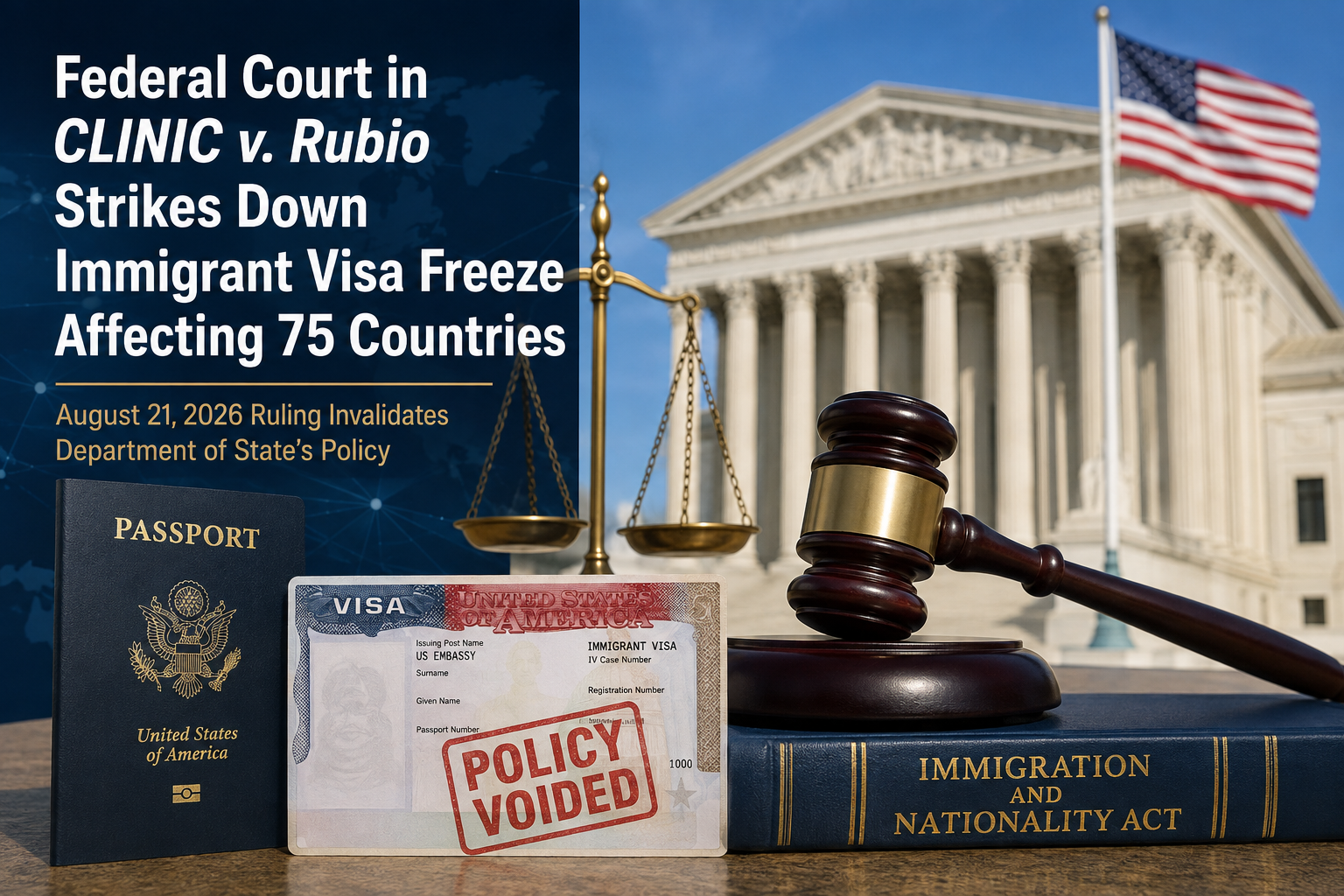
A federal judge has invalidated the U.S. Department of State’s nationality-based policy suspending immigrant visa issuance, impacting 75 countries.
▸ Executive Summary
The federal court's decision in CLINIC v. Rubio has invalidated the U.S. Department of State’s policy that suspended immigrant visa issuance for nationals of 75 countries. This ruling requires the government to revert to individualized adjudication under U.S. immigration law, impacting many applicants. However, it does not affect existing travel restrictions or guarantee visa issuance.
A federal judge has invalidated the U.S. Department of State’s nationality-based policy suspending immigrant visa issuance. The ruling was issued on August 21, 2026, in CLINIC v. Rubio. Although the decision has broad implications, it does not eliminate existing travel restrictions. Nor does it guarantee that any individual applicant will automatically receive a visa. Instead, the court set aside the blanket, categorical policy and required the government to return to the ordinary system of individualized adjudication under U.S. immigration law.
However, an important distinction must be made between the measure affecting 75 countries and the separate Presidential Proclamation restricting entry from 39 countries. The 75-country measure was a policy of the U.S. Department of State. The restriction affecting 39 countries, by contrast, was implemented through a separate Presidential Proclamation and is a distinct legal measure.
The August 21 court ruling invalidated the Department of State’s 75-country policy.
1-What Was the Immigrant Visa Policy Affecting 75 Countries?
On January 14, 2026, the U.S. Department of State announced that it would temporarily suspend the issuance of immigrant visas to nationals of 75 countries. The operative instruction was a diplomatic cable issued by the Department of State entitled Pausing Immigrant Visa Issuances for Nationalities at High Risk of Public Charge. The cable was identified as 26 STATE 3740. The policy took effect on January 21, 2026.
The policy was based on the Department’s assessment that nationals of the listed countries presented a greater risk of becoming a public charge. Consular officers were instructed to refuse covered immigrant visa applications under section 221(g) of the Immigration and Nationality Act (INA). Consular interviews could continue to take place, but immigrant visas could not be issued under the policy.
The Department of State explained that the measure applied to immigrant visas, rather than ordinary nonimmigrant tourist visas. Dual nationals applying with a passport issued by a country that was not included on the list were excluded from the policy. The Department also stated that no immigrant visas previously issued had been revoked pursuant to this guidance.
2-What Did the Federal Judge Decide?
On August 21, 2026, Judge Vargas ruled that the 75-country policy violated federal immigration law and exceeded the statutory authority of the Secretary of State. The court found that the blanket nationality-based refusal policy conflicted with section 221(g) of the INA, with the prohibition on nationality-based discrimination in the issuance of immigrant visas under 8 U.S.C. § 1152(a)(1)(A), and with the Department of State regulation set forth at 22 C.F.R. § 40.6.
The remedy ordered by the court is just as important as the legal ruling itself. Acting under the Administrative Procedure Act (APA), the court ordered that the challenged policy be set aside and vacated. The court also invalidated visa refusals that had been based solely on that policy. In addition, the affected cases were remanded to the agency for reconsideration.
By contrast, visa refusals based on other independent and lawful grounds were not affected by the decision.
3-Does the Decision Apply Nationwide?
The decision is not limited solely to the individual plaintiffs named in the case. Judge Vargas did not merely issue an injunction protecting a limited group of parties. Instead, she used the remedy known as vacatur under the Administrative Procedure Act (APA). Rather than providing protection only to particular individuals, vacatur sets aside the challenged federal agency action itself.
The Department of State therefore may no longer rely on the 75-country policy, which the court has vacated, as a legal basis for denying immigrant visa applications at U.S. consular posts. However, this result remains in effect only so long as the court’s ruling is not temporarily suspended by a higher court through a stay and is not reversed on appeal.
4-How Does the Supreme Court’s Decision Limiting Nationwide Injunctions Affect This Case?
The New York federal court’s decision should be considered together with the Supreme Court’s ruling in Trump v. CASA.
On June 27, 2025, in Trump v. CASA, Inc., the Supreme Court limited the circumstances in which federal district courts may issue relief with nationwide effect.
The Supreme Court’s basic approach was as follows:
A federal district court ordinarily should provide only the relief necessary to protect the rights of the plaintiffs before it. The mere fact that one plaintiff files a lawsuit does not automatically authorize a federal court to block a federal government policy nationwide and as to everyone.
What Does the Decision Mean?
The decision does not mean that “a federal judge’s ruling is valid only within the state in which that judge sits.”
For example, a decision issued by a federal judge in New York is not necessarily limited in effect to the State of New York.
When Can a Federal Court Decision Have Nationwide Effect?
It is important to distinguish between a court’s legal reasoning and the remedy the court orders.
The legal reasoning of a federal district court does not, by itself, become binding precedent on every other federal court in the United States. Another federal judge addressing the same legal issue may reach a different conclusion.
However, the remedy ordered by a court may, in certain circumstances, have practical nationwide consequences.
For example:
If a court issues relief protecting only specific plaintiffs, the ruling generally applies to the extent necessary to protect those plaintiffs.
If the case involves a properly certified class action, the relief may extend to the entire certified class.
If a federal agency action is vacated under the APA, the situation is different. In that circumstance, the court is not merely prohibiting the government from applying the challenged action to particular plaintiffs; it is setting aside the agency action itself.
If the Supreme Court or the relevant federal court of appeals has issued a binding decision, lower courts are required to follow that precedent.
Accordingly, whether a federal court ruling has nationwide effect does not depend simply on the state in which the judge sits. Rather, it depends on the nature of the case, the parties involved, the source of the court’s legal authority, and, most importantly, the type and scope of the remedy ordered by the court.
5-What Happens Next?
Although the August 21 decision has significant consequences, the litigation is not necessarily over.
The federal government may appeal the decision to the U.S. Court of Appeals for the Second Circuit. While the appeal is pending, the government may also ask the court to temporarily suspend the effect of the district court’s vacatur by requesting a stay.
A stay does not arise automatically. A court must separately grant such relief.
The federal district court also entered partial judgment under Federal Rule of Civil Procedure 54(b) with respect to the claims resolved by the decision.
From a practical standpoint, there may also be a short transition period between the issuance of a federal court decision and its uniform implementation across all U.S. consular posts.
Applicants whose cases were refused or placed on hold because of the 75-country policy should closely monitor communications from the National Visa Center (NVC) and the relevant U.S. embassy or consulate.
Where a case involves a filing deadline, a potential aging-out issue, the expiration of a medical examination, a police certificate, or another time-sensitive document, applicants should also consider obtaining legal advice based on the specific circumstances of their case.
6-What Happens to Applicants Whose Immigrant Visa Applications Were Refused?
The court’s ruling is particularly important for applicants whose cases were refused based on the Department of State’s general assessment of the 75 countries. If an applicant’s immigrant visa application was denied without an individualized review of that person’s circumstances, primarily or solely because the applicant was “a national of one of the 75 listed countries,” that refusal resulted from the policy the court has now vacated. The court also set aside refusals that were based solely on that policy and required those cases to be reconsidered by the Department of State.
Accordingly, if, for example, an applicant was refused simply because the applicant was a national of Nepal, Iran, Pakistan, or another country on the list, based on the general assumption that nationals of that country presented a higher public-charge risk, the Department of State may no longer maintain the refusal on the basis of that same country-wide assessment. The case must instead be reconsidered on an individualized basis, taking into account the applicant’s own financial circumstances, age, health, sponsor, sources of income, and other relevant personal factors.
However, the court’s ruling does not result in the automatic issuance of a visa. Consular officers may still reassess the applicant’s visa eligibility and any applicable grounds of inadmissibility through a lawful, individualized review. In other words, what the court eliminated was the approach of “I am refusing you generally because you are a national of this country.” The ruling did not eliminate any independent and lawful ground of refusal that may exist in the applicant’s individual case.
7-Trump’s Separate Travel Restriction Remains in Effect
The August 21 court ruling should not be confused with President Trump’s separate measure, Presidential Proclamation 10998. The Presidential Proclamation was signed on December 16, 2025, and took effect on January 1, 2026. It imposed full or partial entry and visa restrictions involving 39 countries, as well as certain travel documents issued or endorsed by the Palestinian Authority.
Judge Vargas’s August 21 ruling addressed the Department of State’s 75-country immigrant visa policy based on public-charge concerns. The court did not invalidate Presidential Proclamation 10998.
Accordingly, even if an applicant benefits from the invalidation of the 75-country policy, that same applicant may still remain subject to a separate restriction under the Presidential Proclamation or another immigration rule.
8-What Should Immigrant Visa Applicants Affected by This Policy Do Now?
- Do not assume that a prior refusal has automatically become an approval. The court invalidated refusals based on the policy and returned those cases to the government for further action.
- Review the refusal notice and the procedural history of the case. It should be determined whether the refusal was based solely on the 75-country policy or whether other grounds of refusal were also cited.
- Determine whether a separate restriction still applies. In particular, applicants should assess whether Presidential Proclamation 10998 or another immigration rule applies based on their nationality, passport, or individual circumstances.
- Monitor communications from the National Visa Center and the relevant U.S. embassy or consulate for case-specific instructions. Following a significant court ruling, a consular post may require some time to reopen a case or conduct a new adjudication.
- Where timing is critical, seek individualized legal advice rather than relying solely on general news reports.
Frequently Asked Questions
Conclusion
The August 21, 2026 decision in CLINIC v. Rubio represents a significant development for immigrant visa applicants affected by the Department of State’s 75-country policy. The court invalidated both the blanket nationality-based policy and refusals based solely on that policy. As a result, unless the ruling is stayed or reversed on appeal, the Department of State must return to a lawful system of individualized adjudication.
At the same time, the scope of the ruling is narrower than some headlines may suggest. The decision does not broadly invalidate all visa restrictions adopted during the Trump administration. It does not guarantee that any applicant will receive a visa, and it does not reverse prior removal or deportation actions. The reason is straightforward: the 75-country policy was not a deportation program. It was a consular policy governing the issuance of immigrant visas.
If your immigrant visa application, or that of a family member, was refused or placed on hold because of the 75-country policy, an immigration attorney can review the legal basis for the refusal, identify any other restrictions that may still apply, and advise you on the appropriate next steps before the National Visa Center or the relevant U.S. consular post.
This article is provided for informational purposes only and does not constitute legal advice. Immigration law is complex and fact-specific. Please consult a licensed immigration attorney regarding your individual circumstances.
Latest News
-
 02 Oct 2026
EB-5 Filing Fees Nearly Double: What Investors Must Know Before November 30, 2026
-
 29 Sep 2026
E-1 Visa Guide for Companies and Entrepreneurs
-
 19 Sep 2026
US Immigration Solutions for Business: E-2, EB-2 NIW, and EB-5
-
 17 Sep 2026
Birthright Citizenship and Green Card Rules for Children of Foreign Government Employees
-
 14 Sep 2026
DHS Proposes Eliminating the 60-Day Grace Period for Foreign Workers Whose Employment Ends